Every entrance controlled.
Every visitor known.
Ontario's Safe Schools Act requires schools to manage unauthorized entry and respond to campus threats. Licensed daycares must meet security standards for CCEYA licensing. We install visitor-managed access control and camera systems that satisfy Ontario's requirements — and give principals and directors real oversight of who enters their buildings.
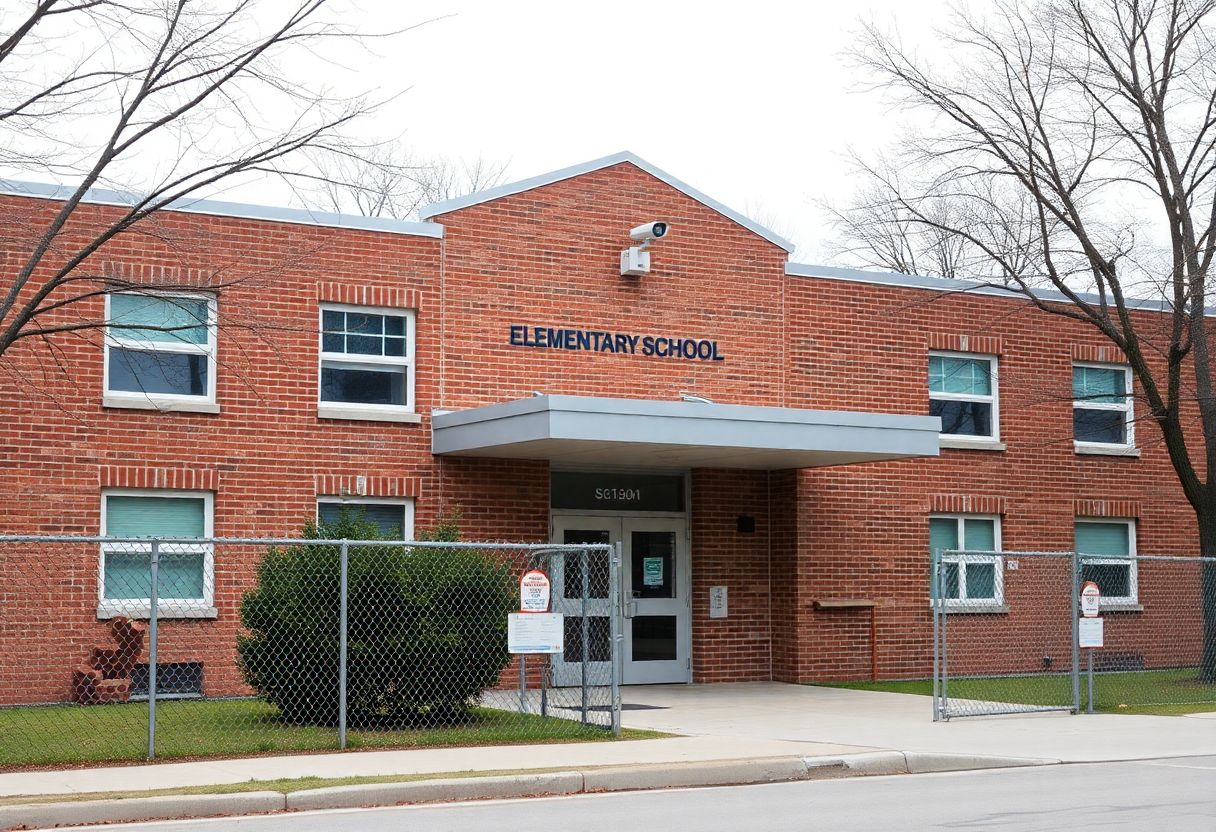
Open all day. Accountable all year.
A school or a daycare cannot be locked down the way a warehouse can. Children move between the main building and the portables, families arrive at pickup in a fifteen-minute wave, and staff prop the side door because the alternative is walking a class around the building in the rain. The people below have to hold that openness and still be able to say exactly who came in.
Usually read by: Principal / daycare director / school board facilities manager
The principal or vice-principal
- Your day
- You are in the hallway at entry, at the office window when the buzzer goes, and outside at dismissal. Between those you handle a custody arrangement that changed last week, a visitor who does not want to sign in, and a caretaker telling you the gym door is not latching again.
- What you're judged on
- Being the person who made the entry decision. You are answerable to families and to your board for anything that happens on site, and the thing you replay afterwards is never the hardware — it is the moment somebody was let in and nobody could describe them later.
The licensed daycare director or owner-operator
- Your day
- You run a room count, a staffing ratio, a sign-in sheet and a pickup authorization list, usually while covering a room yourself. Parents arrive throughout the day, a supply staff member needs the door code, and the same front door serves families, deliveries and the landlord's contractor.
- What you're judged on
- Your licence. Anything that touches access to the areas children use will be looked at, your policies have to match what actually happens at the door, and you carry the additional weight of being a small operator with no facilities department behind you.
The board facilities manager
- Your day
- You are responsible for dozens of schools, a standards document, a summer capital window, and a vendor list that determines who is allowed to touch a building. Your year is built around the weeks when schools are empty, because that is when work can happen.
- What you're judged on
- Consistency and procurement. You need the same hardware and the same procedure at every school so a caretaker can be reassigned without retraining, and you need every purchase to stand up to a competitive process. An installation done well at one school and badly at the next is your problem, not the principal's.
A door alarm goes off at 11 PM in July. Who is expected to attend?
In most cases it is the caretaker on the call-out list, alone, driving to a dark building to check a door — and if the alarm is not verified, that trip happens for wind and for raccoons as often as for anything real. Where a camera is tied to the same door, the picture changes before anyone drives anywhere: the event is looked at, and either it is nothing and the caretaker sleeps, or somebody is at the portables with a pry bar and police are called with a description and an exact location on the property. During the school year the same principle applies to the front entrance, where the point is not response at all — it is that the person pressing the release can see who is asking before the latch opens, and that the visit is recorded whether or not anyone signs the book.
Same protocol whether the site is in Oshawa or anywhere else we cover.
The things people in your position actually ask us
“Will this make us compliant with our licensing or our board's requirements?”
We will not tell you that, and you should be careful with anyone who does. Compliance is determined by your licensing specialist or your board, and what they ask for varies by site and by year. What we do is build to the written requirement you hand us, and produce the documentation that supports your submission — where cameras and readers are placed, what they cover, what is logged, how long it is kept. If your ministry consultant or board reviewer asks for something different from our design, we change the design.
“We cannot lock everything. Classes go in and out of the portables all day.”
Then do not try to lock everything. The pattern that works is one controlled entrance for anyone who is not staff or a student, with the portable and yard doors free to exit and credentialled to enter for staff. That way a class comes back in on a teacher's fob, a parent goes to the office, and nobody has to choose between a rule and getting thirty children out of the rain. Design that forces staff to break it is the reason side doors end up propped with a wooden wedge.
“Parents are going to ask whether you are recording their children.”
They will, and the answer should be ready in writing before installation rather than improvised at a council meeting. Coverage is normally at entrances, exterior approaches, hallways and yards — not in classrooms, sleep rooms, washrooms or change areas, and we will not design those. We provide the signage, the coverage map and the retention setting so the person explaining it to families has something concrete, and we confirm those limits against your board's or your licence-holder's own policy rather than asserting what is permitted.
“Staff will prop the side door anyway because the buzzer takes too long.”
That is a timing problem, not an attitude problem. If the office is answering a buzzer from two rooms away while a class is lined up outside, propping is the rational move. The fixes are practical: put the intercom where the person answering actually sits, give staff a credential on the doors they use daily so they never need to be let in, and put a contact on the propped door so it is a known event rather than a discovery. Alarms that fire at the same door every morning at 10:15 get ignored, and then all alarms get ignored.
“Our board already installed cameras. We just cannot get a clip out of them.”
Very common, and it is usually an account problem rather than a camera problem. Before we quote anything, we check whether the existing recorders are healthy, whether they are still writing, what the real retention is, and who holds the administrator credentials — which is often a contractor nobody at the school has spoken to in years. If the cameras are fine and the answer is role-based logins so a principal can pull a clip without a service call, we will tell you that and the job is small.
“We are a single-room daycare in a leased unit. Is this not overkill for us?”
Probably, if we quoted you what a school gets. A small licensed centre with one entrance usually needs a camera-intercom at that door, a lock that latches reliably, a code or fob for staff with a log, and a camera covering the exterior approach. That is the whole project. If somebody is proposing eight cameras and a monitoring contract for a single-room centre, ask them which specific incident each camera is for.
Unauthorized access is the primary risk.
Ontario's Keeping Our Kids Safe Act (Bill 157) requires school principals to develop procedures for reporting and responding to dangerous individuals on school property. The operational challenge is visitor control: most Ontario schools rely on a front-office buzzer system — but without camera visibility at the door, staff are making entry decisions without seeing who is requesting access.
After-hours break-ins are the second major risk. Ontario schools report thousands of break-in incidents annually — targeting electronics, AV equipment, and cash. Most occur between 10 PM and 4 AM with no monitoring active. Licensed daycares face an additional regulatory layer: the Child Care and Early Years Act (CCEYA) requires documented access control for all child-accessible areas.
In Oshawa, schools and licensed daycares face the same visitor management and after-hours break-in pressures seen across the Durham Region region. Our camera and access systems give Oshawa principals and directors complete campus visibility — and the documentation Ontario's Safe Schools Act and CCEYA require.
Case Study — GTA Elementary School
Two break-ins in one semester — projectors and laptops stolen both times. School board approved a camera and access upgrade. Riowell installed cameras at all exterior doors, an intercom-with-camera at the main entrance, and after-hours motion alerts. Zero break-ins in the following school year. Footage from a vandalism attempt during March Break resolved a police investigation within 24 hours.
High-Risk Areas in Schools & Daycares
School & Daycare Security in Oshawa — what we actually see.
Oshawa's school security landscape reflects the city's GM-legacy working-class identity and its ongoing economic transition. Durham DSB and Durham Catholic DSB schools across Oshawa's Lakeview, Vanier, and McLaughlin neighbourhoods — the city's older core areas — see a moderate-to-high frequency of after-hours break-ins, primarily targeting electronics and sports equipment. The pattern in Oshawa differs slightly from GTA cities: theft of sports equipment (hockey bags, lacrosse gear, gym inventory) is more common here than in most other cities, reflecting the community's strong hockey and athletics culture. Eastbound Highway 2 corridor schools near the Simcoe Street North industrial transition zone face the highest incidence. Independent private schools in the Taunton Road and Kedron corridor — serving Oshawa's growing suburban residential population — have higher electronics inventories and lower historic security investment. Licensed daycares in Oshawa's newer residential nodes near Harmony Road and Taunton Road are expanding with the city's commuter growth. The Durham Police Service's community-facing social media has highlighted school and community centre break-ins in Oshawa as a persistent property crime priority.
Sports equipment theft alongside electronics
Oshawa schools experience a higher rate of sports equipment theft than most GTA cities — hockey bags, lacrosse gear, and gym inventory stored in unsecured secondary storage rooms are common targets. Camera coverage on gymnasium storage corridors and secondary exits is a specific priority in Oshawa school designs.
Lakeview and Vanier core school vulnerability
Oshawa's older core neighbourhoods around Lakeview and Vanier concentrate the city's highest school break-in frequency. After-hours camera coverage and monitoring at these campuses is the baseline that consistently separates schools that experience recurring incidents from schools that don't.
Taunton Road suburban school electronics gap
Oshawa's newer Kedron and Taunton Road suburban schools have modern electronics inventories — 1:1 devices, updated AV — but security infrastructure that hasn't kept pace. A targeted camera upgrade at secondary exits and portables is a cost-effective way to protect that investment.
Police Coordination — Oshawa
Durham Regional Police Service handles all school incident response in Oshawa. We coordinate with DRPS and pre-register school addresses, entry layouts, and after-hours staff contacts. For Lakeview and Vanier schools with documented high-incident histories, we maintain expedited dispatch contacts with the DRPS patrol division assigned to that school's address.
Client Story — Oshawa
Durham DSB elementary school, Lakeview — 11 months under monitoring
470-student school, two portables, gymnasium storage room with sports equipment. Prior year: two break-ins — laptop cart and full hockey equipment cache stolen ($17,400 total), both through a gymnasium secondary exit with no camera. We installed 8 cameras — gymnasium secondary exit and storage corridor, portable exteriors, all main-building exterior exits. After-hours monitoring active. In 11 months: two attempted entries on the gymnasium exit — both intercepted by operator audio challenge, one DRPS dispatch. No losses. The principal reported the sports equipment recovery from the prior theft was never completed — the new system prevents the same loss recurring.
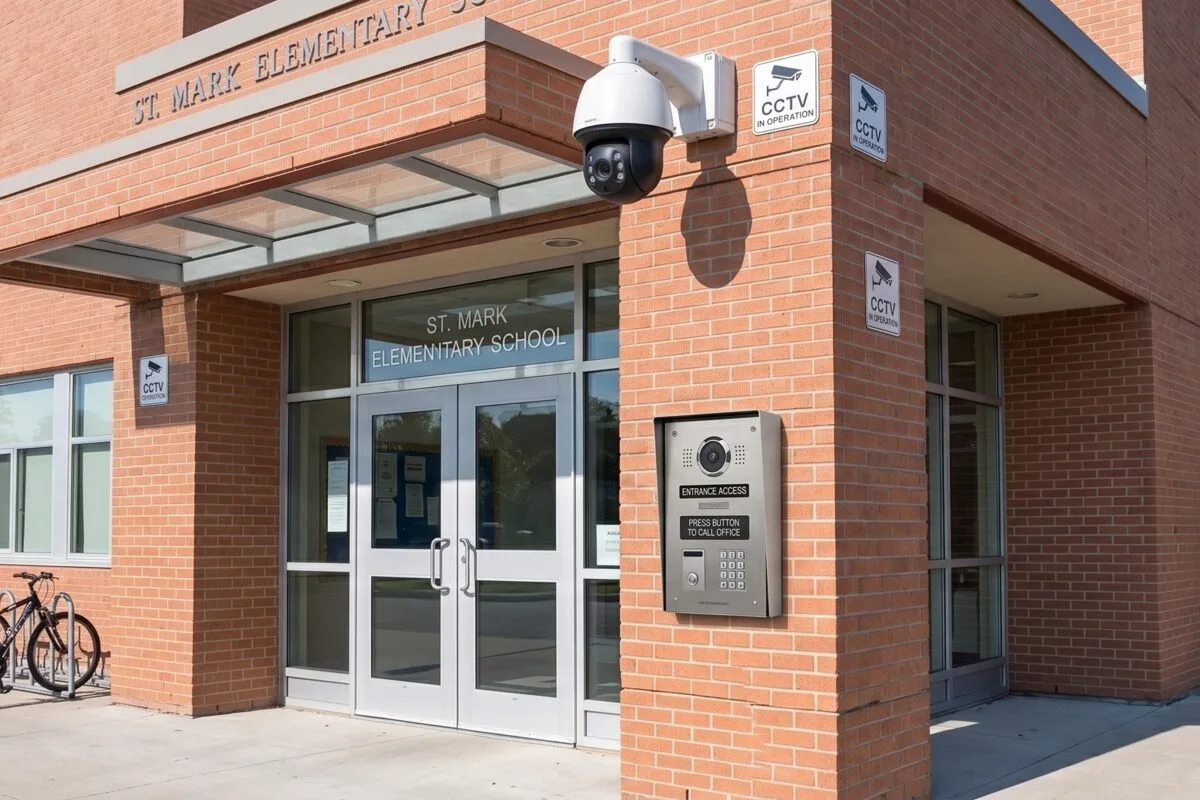
Visitor Management
A buzzer without a camera
is a blind decision.
Most Ontario schools have a front-door buzzer — but when staff press the button to see who's there, they're making a decision with no visual confirmation. A camera at every entrance gives staff a verified view before granting access. The decision takes 10 seconds and the record is permanent.
Campus secured in under two weeks
Campus Walk-Through
We assess every entrance point, after-hours perimeter, portable classrooms, and equipment storage areas. We map current camera blind spots and identify which access points need controlled entry — with specific attention to CCEYA-required zones in daycare settings.
Camera & Access Installation
Intercom-with-camera at the main entrance for visitor verification before buzzing in. 4K cameras at all exterior doors, parking lots, and high-risk interior zones. Card or fob access on staff-only and child-accessible areas. Installed during a non-school day where possible.
Admin Control & After-Hours Monitoring
Principal or director accesses all cameras from one dashboard. After-hours motion alerts on perimeter and interior. Footage retained 30 days — searchable for any incident, exportable for police or school board within minutes.
Complete campus protection
Intercom + Camera at Main Entrance
Staff see every visitor on a screen before buzzing them in — from the front office or any authorized station. Visitor interactions are recorded. Visitor log available for any compliance or incident review.
Exterior Door & Perimeter Cameras
4K cameras at every exterior door capture faces and clothing detail in any lighting. Parking lot and field perimeter coverage reduces after-hours break-in risk and supports police investigations with clear identification-quality footage.
Staff & Restricted Area Access Control
Card or fob access on staff offices, server rooms, and CCEYA-required child-accessible areas in licensed daycares. Revoke credentials instantly. Full audit trail of every access event for school board or regulatory review.
After-Hours Intrusion Alerts
Motion-triggered alerts to the principal's or caretaker's phone when after-hours activity is detected. Live monitoring option available for boards wanting police dispatch response rather than notification-only.
Portable Classroom & Outbuilding Coverage
Wireless cameras for portables and outbuildings — no conduit run required. Solar-powered options for remote structures. All connected to the same management platform as the main building.
Incident Documentation for School Board
Every incident produces a timestamped clip package ready for school board review, police, or insurance within minutes. Monthly access and incident reports available for board format. CCEYA compliance documentation provided for licensed daycares.
Client Results
What school & daycare security clients say
“A parent dispute at pickup turned into a confrontation at the front entrance. Without camera footage it would have been he-said she-said. We had clear footage from the intercom camera. The situation was handled by administration without police involvement.”
“Our daycare license renewal required upgraded exterior camera documentation. Riowell met with our licensor, confirmed compliance requirements, and installed accordingly. The inspector signed off on the first visit. That peace of mind is invaluable when our license is at stake.”
“We had an unauthorized vehicle parked in the fire route repeatedly. The cameras gave us plate footage. One letter from admin to the owner with a screenshot ended it. That's what good coverage does — it stops problems before they escalate.”
“We had two break-ins in one semester — both through a side door with no camera. Riowell installed cameras on all exterior doors plus an intercom-with-camera at the main entrance. Staff can now see who's at the door before buzzing them in. We haven't had a break-in since, and when there was a vandalism attempt during March Break, the footage had the case closed in 24 hours.”
Every entrance visible.
Every access logged.
Book a free campus walk-through. We'll map every entrance, blind spot, and after-hours risk zone — and design a system that meets Ontario Safe Schools requirements, CCEYA standards for daycares, and your school board's approval process.
Security for Schools & Daycares beyond Oshawa
We cover Oshawa and 14 other Southern Ontario communities. Every location gets the same technicians, the same equipment, and the same response commitment — pick yours below.
Related properties we protect
Frequently Asked Questions
Ready to secure
your business?
Book a free on-site assessment. We'll evaluate your property and design a custom security and IT solution — no pressure, no commitment.