AGCO compliant.
Fully protected.
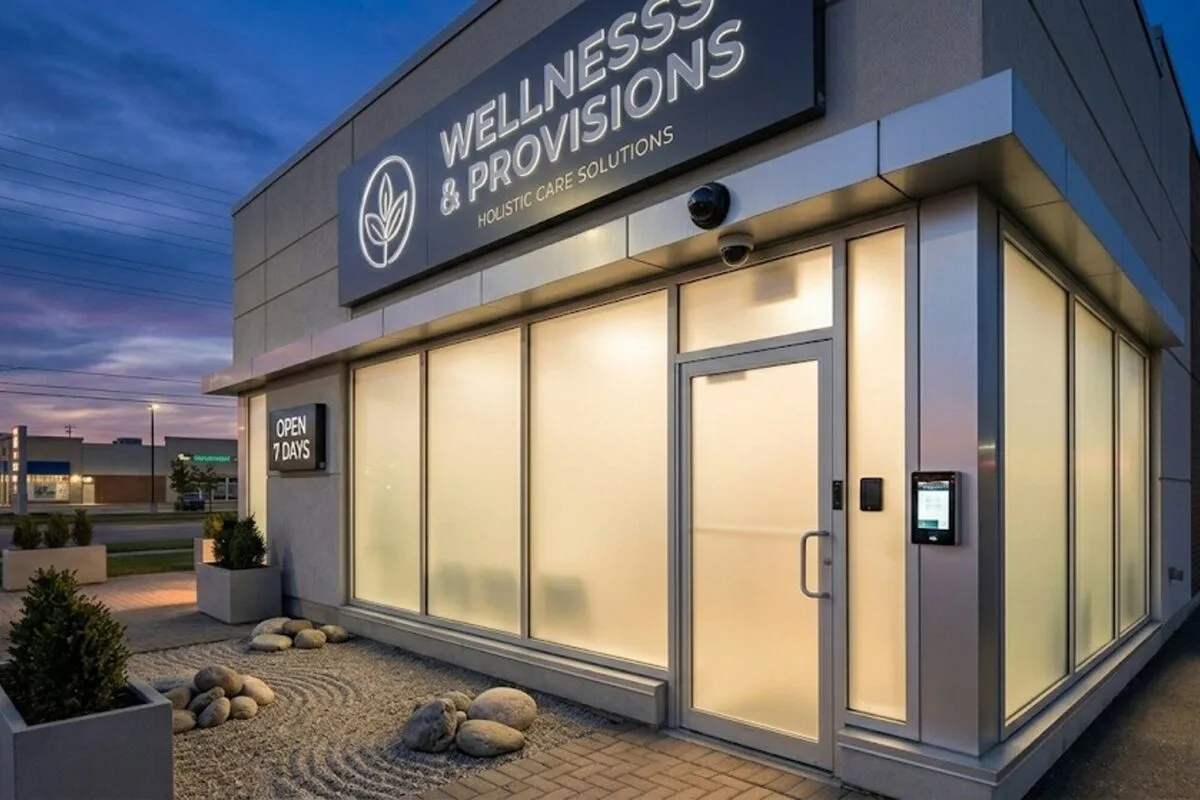
Ontario's 1,799 licensed cannabis stores face a dual threat: mandatory AGCO security requirements with penalties up to $100,000 — and rising smash-and-grab break-ins targeting dispensaries after hours. We install ULC-certified camera and access systems that satisfy every compliance requirement and stop unauthorized entry before it becomes a police report.
Theft is the loss you can survive. The licence is not.
Every other retail operator on this site is weighing what an incident costs. In cannabis the calculation is different: a break-in is a bad month, and a finding on an inspection can be the business. That is why the questions we get from this sector are almost never about deterrence — they are about coverage of specific areas, retention, records, and whether what is installed matches what the operator has told their regulator is installed.
Usually read by: Cannabis retailer / licensed producer / dispensary owner
The retail store owner
- Your day
- You are running a single store or two, managing staff on the floor, the age-check routine at the door, and the transfer from the back room to the sales floor. Your security system was installed at build-out by whoever the contractor used, and you have not thought about it since the day you opened.
- What you're judged on
- An inspection that finds something you did not know was wrong. You did not design the system, you inherited it, and you are the one whose name is on the licence when a gap is written up.
The licensed producer's compliance lead
- Your day
- You live in records. Access lists, visitor logs, camera coverage maps, retention, reconciliation variance, and the standard operating procedures that have to match what actually happens in the building. You walk the site looking for the gap between the document and the reality.
- What you're judged on
- Being asked for footage of a specific area on a specific date and finding out then that a camera had been offline, or that the angle does not cover what the coverage map claims it covers. Your defence is the record, and the record has to hold up without you being in the room.
The dispensary general manager
- Your day
- You open, you close, you count, and you manage the back-of-house door that staff keep propping in the summer. You handle the vault transfers, the shift changes, and the reconciliation that has to balance before you go home.
- What you're judged on
- Internal diversion, and the fact that you cannot raise it with anyone without something solid. A variance you cannot explain is both a staffing problem and a reporting problem, and the second one is worse.
Glass goes through at 3 AM. And then what has to happen by morning?
The alarm calls the manager, then the owner, then nobody, and someone drives in to see whether it is real — that part is the same as any retail store. What is not the same is the next twelve hours. You are cleaning up, securing product, and at the same time assembling a record of what happened, what was taken, and what the cameras covered at the moment it happened. With after-hours monitoring an operator confirms the entry and calls police while it is live, which matters — but the part operators tell us they value more is that the incident produces an exportable, timestamped record by morning rather than a scramble through a recorder nobody has logged into since installation.
The things people in your position actually ask us
“We passed our last inspection. Why would I touch any of this?”
If your coverage matches your own documented plan, your retention is intact, and you can export footage on request, then you are in good shape and we would tell you to leave the system alone. Where we are usually useful is a few hours of review rather than a replacement — confirming the cameras still cover what the coverage map says, that nothing has been repositioned during a renovation, and that the retention is genuinely holding the full window. That is a small piece of work and it is priced like one.
“Our installer told us we were compliant. I have nothing in writing that says so.”
That is the common position, and it is the thing worth fixing first. What we produce is a written record: a camera coverage diagram over your floor plan, the model and position of each unit, the configured retention, and the monitoring arrangement. We are documenting what is installed and confirming it against the standards your licence is held to — we are not the regulator and we do not speak for them, which is exactly why the document is written so you can hand it to someone who does.
“If someone asks for footage from three weeks ago, I need it the same day.”
Then the retention and the export path both need testing, not assuming. We confirm the recorder is actually holding the full window rather than overwriting early because a channel was added later, and we walk your manager through pulling and exporting a clip so the first time it is done is not under pressure. Cloud retention is worth discussing for the same reason a recorder in the back room is a single point of failure in a break-in.
“If a camera goes down, would I even know?”
On a lot of sites, no — the failure is discovered when someone goes looking for footage. Health monitoring on each channel means an offline camera raises an alert to you and to us rather than sitting dark for a fortnight. In this sector that is not a convenience feature. A gap in coverage you did not know about is materially worse than one you found and logged.
“The real risk is staff, and I cannot raise it with anyone without proof.”
That is why the access record matters as much as the camera. Controlled access on the back room, the vault and the receiving door turns every entry into a logged event with a name and a time, and the footage sits against it. That combination is what turns a variance you cannot discuss into a specific date and a specific person. We build the logging and the coverage; how you handle the conversation afterwards is your call and usually your employment counsel's.
“We are a producer, not a store. Half of what you have written here is about retail.”
It is, and a production site is a different design. The pressure points are receiving, the vault or storage room, packaging and destruction areas, the corridors between them, and visitor and contractor access — not a sales floor. If your site is a production facility, tell us at the first conversation so the walk-through follows your own site plan and your own written procedures rather than a retail template.
Compliance gaps cost your licence.
The AGCO requires 24-hour camera surveillance of all entrances, exits, point-of-sale areas, receiving areas, and storage locations — with a minimum 30-day retention. In 2023–2024, AGCO conducted 2,820 inspections and cited 937 violations. A missed camera angle, a retention gap, or an access control failure can trigger a monetary penalty or licence suspension.
The external threat compounds the compliance requirement. Ontario cannabis dispensaries face organized smash-and-grab teams that survey locations in advance — identifying camera blind spots and security gaps before targeting after-hours. With $5.5 billion in Canadian cannabis sales in 2024–2025, the inventory value makes dispensaries a primary target.
Case Study — Brampton Cannabis Retailer
Single-location dispensary with a camera system that didn't cover the receiving area — an AGCO violation identified on inspection. Riowell conducted a compliance gap audit, added two cameras, upgraded to 30-day cloud retention, and provided the AGCO-format documentation. Passed the follow-up inspection. Subsequently had an after-hours break-in attempt that was stopped by live monitoring dispatch.
AGCO-Mandated Coverage Areas
Compliance & Protection
A violation isn't
just a fine.
AGCO compliance violations can trigger licence suspension — meaning your store closes until resolved. The penalty isn't only monetary; it's operational. A compliant, monitored camera system is the cheapest insurance against both a six-figure fine and a forced closure.
AGCO compliant in under two weeks
Compliance Gap Audit
We map your facility against AGCO's camera coverage requirements: all entrances, exits, POS areas, receiving areas, and storage locations. We identify any gaps and provide a written compliance report — what's covered, what's missing, and exactly what's needed to satisfy the standard.
AGCO-Compliant System Installation
Commercial-grade cameras installed at every required location with 30-day cloud retention. Access control on staff-only areas. System configured and documented to AGCO submission standards. Installation completed without disrupting store operations.
Monitoring, Retention & Documentation
24/7 monitoring with immediate alert on after-hours access. Footage retention managed and guaranteed — 30 days minimum, exportable on demand. Compliance documentation package provided for AGCO submissions, insurance, and any inspection response.
Full compliance and full protection
AGCO-Compliant Camera Coverage
Commercial-grade 4K cameras at all locations named in the Registrar's Standards: entrances, exits, POS areas, receiving, and storage. Coverage mapped against the Registrar's Standards — no gaps, no violations. Compliance documentation ready for AGCO submission.
30-Day Cloud Retention
Footage stored for 30+ days as required by AGCO. Cloud-based retention means footage is preserved even if on-site hardware is damaged or stolen. Exportable within minutes for AGCO inspection requests, police, or insurance.
Staff-Only Access Control
Card access on storage rooms, receiving areas, and back-of-house. Every entry logged with staff ID and timestamp — your primary defence against the 90% of cannabis losses that come from internal sources. Revoke access instantly when staff leave.
After-Hours Monitoring
Live operators monitor your dispensary after close. Smash-and-grab teams that survey locations are identified by pre-theft surveillance behaviour. Any after-hours door, window, or perimeter access triggers verification and a call to police on a verified intrusion.
Compliance Documentation Package
System specification, camera coverage diagram, retention certificate, and monitoring certificate — all formatted for AGCO inspection response. New retailers receive a compliance package suitable for initial licence applications and ongoing inspections.
POS & Vault Area Coverage
High-resolution cameras covering all POS terminals and cannabis storage vaults. Internal theft from these areas is the #1 source of cannabis retail loss. Access logs and footage provide evidence for any HR, police, or insurance investigation.
Client Results
What cannabis facility security clients say
“Health Canada inspection flagged two camera blind spots. Riowell had the remediation done in 48 hours with documentation ready for the re-audit. We passed without conditions. That turnaround time is why we keep them on retainer.”
“Internal diversion is the compliance nightmare everyone in this industry knows. After Riowell installed dual-authentication on our vault and camera coverage at every packaging station, our monthly reconciliation variance dropped to under 0.1%. Our QAP sleeps better now.”
“We had a culture of propping open fire doors in the back. Riowell integrated door sensors with the camera system so every prop triggers an alert and a recording. We issued three written notices in the first month. The behavior stopped completely. Compliance audit has been clean since.”
“AGCO came in and cited us for a receiving area that wasn't covered. We had cameras — just not in the right places. Riowell did a full compliance audit, installed what was missing, and gave us the documentation to respond to the citation. Passed the follow-up. Since then we've had one break-in attempt — monitored and stopped before they got through the door. Worth every dollar.”
AGCO compliant.
Fully protected from day one.
Book a compliance assessment. We'll map your facility against AGCO's Registrar's Standards, identify every gap, and have you compliant — with documentation — in under two weeks.
Opening soon? Start compliant.
New cannabis retail licences require AGCO-compliant security systems before opening. We provide the system, the documentation, and the compliance package your licence application needs. Most new locations are installation-ready in under two weeks.
Where we protect Cannabis Facilities
Riowell technicians are dispatched from Mississauga across the GTA, Golden Horseshoe, and Southwestern Ontario. Each page below covers the risk pattern, and the local context specific to that city.
Related properties we protect
The systems behind this
Frequently Asked Questions
Ready to secure
your business?
Book a free on-site assessment. We'll evaluate your property and design a custom security and IT solution — no pressure, no commitment.