Every facility.
One dashboard.
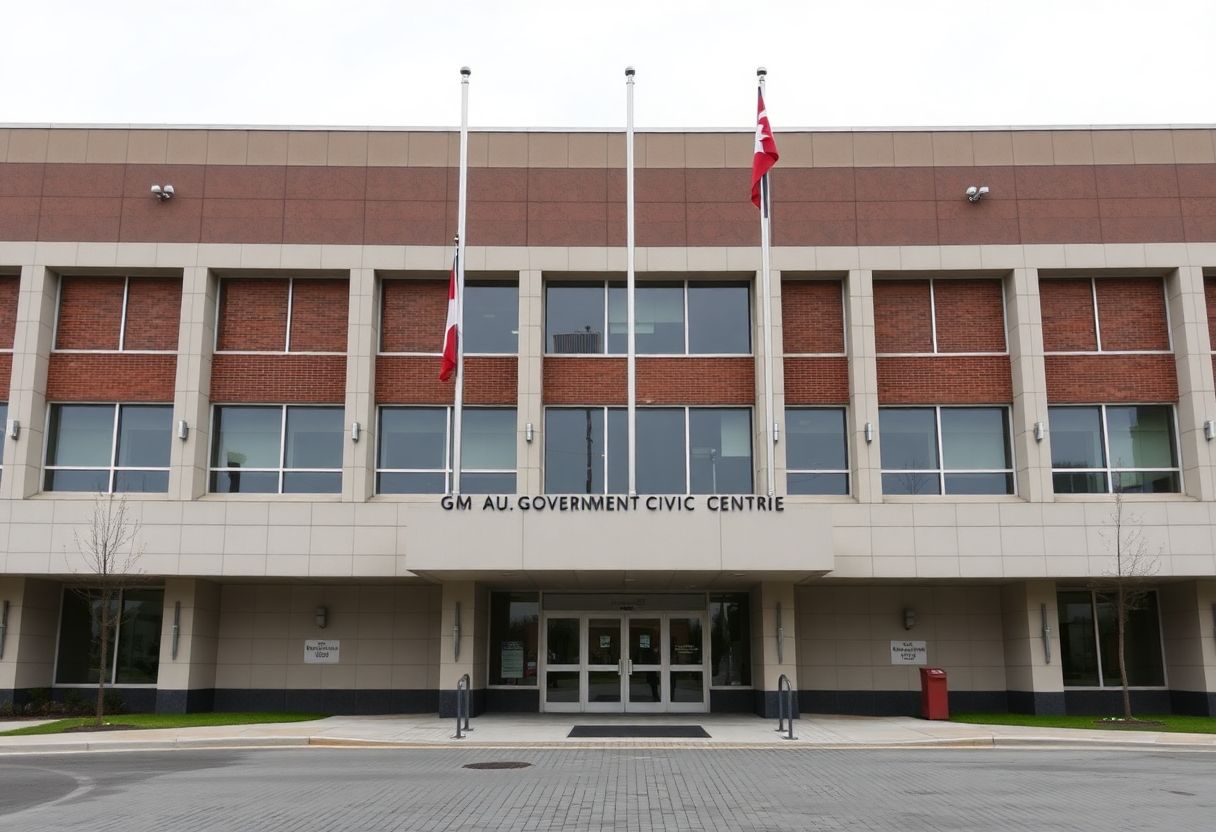
Ontario's 444 municipalities operate hundreds of facilities — community centres, public works yards, transit terminals, and civic buildings — each a target for after-hours theft, vandalism, and unauthorized access. We install camera and access systems that give facilities directors complete oversight across every site, from a single management platform.
The constraint is not the risk. It is the budget cycle.
Municipal facilities staff rarely need persuading that the works yard is exposed. What they need is a scope that survives a procurement process, a number that fits a capital line approved months in advance, and wording they can put in a report that a member of the public is entitled to read. Everything here is written for people spending other people's tax dollars in public.
Usually read by: Director of facilities / municipal manager / public works superintendent
The director of facilities
- Your day
- You are responsible for the arena, the library, the town hall, the water plant, the operations centre and a set of buildings nobody thinks about until a pipe bursts. Your week is capital forecasts, condition assessments, contractor coordination and a master-key system you inherited that opens more doors than anybody can list.
- What you're judged on
- Defending a spend in a public forum. Every project you bring forward will be compared to a road, a rink floor or a bridge deck, and if you ask for security money the year after nothing happened, the question is why now. You also know that if something does happen, the previous report recommending the work becomes part of the record.
The public works superintendent
- Your day
- You run the yard — plows, loaders, road salt, diesel, copper, signage stock, and a fuel island that sits open to a fence line nobody watches after the last crew leaves. In winter you have staff coming and going at any hour, which means the yard is never reliably empty and never reliably attended.
- What you're judged on
- A stolen loader or a night of fuel siphoning is not just a loss, it is a service disruption with a council question attached. You are also the one who has to explain to your own crew why the gate code changed again after equipment walked out, without accusing anybody of anything.
The recreation or community centre manager
- Your day
- Your building is public by design. Permit holders have the hall on Saturday, a minor sports group has the change rooms at six in the morning, a community group runs a program in the multipurpose room on Tuesday nights, and every one of those groups has been handed a key or a code at some point.
- What you're judged on
- Damage and misuse that nobody will claim, and the safety of staff who close the building alone. You are measured on keeping the facility open and welcoming, so anything that makes residents feel policed in their own community centre is a problem for you even when it reduces vandalism.
The yard gate sensor trips at 1 AM in February. Who is woken up?
At most municipalities the honest answer is the on-call superintendent, then the duty operator, then nobody — and in a snow event that person is already out on a route and cannot get to the yard. Because winter operations mean legitimate night activity, an unverified alarm is usually assumed to be a plow operator, which is exactly what makes it useless. Verification is the change that matters: somebody looks at the camera, distinguishes a crew member fuelling at the island from a pickup backed up to the copper storage, and calls police with a plate and a direction of travel rather than reporting an alarm of unknown cause. It also produces the artifact your finance department and your insurer both want afterwards, which is a time-stamped record of what happened rather than a morning estimate.
Same protocol whether the site is in Oshawa or anywhere else we cover.
The things people in your position actually ask us
“Anything over our threshold has to go out to tender. Can you even quote us directly?”
We work either way. Below your municipality's direct-engagement limit we can quote and proceed; above it, we expect to respond to a posted RFP like anybody else, and we are equally willing to provide a specification your purchasing department can put out to competitive bid without our name on it. We will tell you plainly which category we think your scope falls into rather than splitting a project to keep it under a threshold, because that is the kind of thing that ends up in an audit.
“Our capital budget is set in the fall for next year. Nothing happens outside of that.”
Understood, and it shapes how we work with you. The assessment and the written scope are the deliverables that matter in the fall, because that is what your report to council needs — scope, cost, phasing and what the risk is if it is deferred. Work usually starts well after the approval. If something genuinely cannot wait until the next cycle, we would rather help you scope a small operating-budget measure at that one site than pretend an urgent capital request is easy to get through.
“This will be on a public agenda. How do we explain cameras on municipal buildings?”
By being specific about where they point and why, and by having the policy written before the vote rather than after. In practice that means coverage of yards, equipment, fuel, entrances and parking areas; signage at every approach; a stated retention period; and a named staff role who can release footage and on what grounds. Residents object far less to a camera on a salt dome than to a vague security program with no documented limits, and the report reads better when the limits are part of the proposal.
“If someone requests the footage or the access logs, do we have to hand them over?”
That is a question for your clerk and your privacy lead, and we build the system so their answer is straightforward rather than assuming it for them. What we provide is the technical side they need in order to decide: what is recorded, where, for how long, who has viewing rights, and an export that can be redacted. We confirm retention and access rules with your municipality before commissioning, and we put them in the operating documentation so the next director does not have to reconstruct them.
“We have forty buildings and enough money for about six. Where do we start?”
With incident history and asset value, not with the buildings that are most visible. In most municipalities that puts the operations yard first, then any site storing fuel, tools or copper, then facilities with a documented after-hours damage record. If your works yard is the whole exposure and everything else is a parking-lot debate, our recommendation will be to spend the entire allocation on the yard and leave the town hall alone this cycle. A thin layer across forty sites is the version that gets criticized later.
“Our hall is rented to community groups every weekend. We cannot badge every volunteer.”
You should not try. Permit holders are better handled with codes issued per booking that expire when the booking does, so nobody accumulates a key over three seasons of running a program. The credentialled side is for staff and contractors. That split also makes damage conversations far simpler, because when a hall is found damaged on Sunday morning, the record shows which permit window was open rather than putting your facility staff in the position of accusing a resident group without evidence.
Public property is public target.
Municipal facilities face a distinct risk profile: high public traffic during operating hours, and near-zero oversight after hours. Community centres, transit yards, and public works depots are targeted overnight for tools, equipment, fuel, and copper wiring. Vandalism at civic buildings and parks infrastructure costs Ontario municipalities tens of millions annually.
The access control challenge compounds the risk. Many Ontario municipal buildings still operate on master-key systems — one compromised key grants access across multiple buildings. A card or fob system with revocable credentials and a full audit trail eliminates that exposure entirely.
In Oshawa, municipal facilities — from community centres to public works depots — face the same after-hours theft and vandalism pressures affecting municipalities across the Durham Region region. Our multi-site camera and access systems give Oshawa facilities teams complete oversight from a single dashboard.
Case Study — GTA Regional Municipality
Public works yard with three overnight fuel thefts in six months — siphoning from municipal vehicles. Riowell deployed perimeter cameras, motion-triggered alerts, and access-controlled fuel storage. Zero incidents in the following 12 months. Audit trail provided to the municipality's insurance broker reduced the facility premium 17%.
High-Risk Zones in Municipal Facilities
Municipal Government Security in Oshawa — what we actually see.
Oshawa's municipal facility estate of approximately 60 city-owned properties spans the city's working-class GM-legacy geography — the public works complex on Adelaide Avenue East is the city's highest-risk overnight municipal site, and the City's transit maintenance yard on Stevenson Road has experienced both fuel theft and bus-part theft. Oshawa's community centres in the Lakeview, Vanier, and McLaughlin areas face the city's highest vandalism rate — consistent with the commercial property crime pattern in those neighbourhoods. The VIVA/DRT transit terminal at the Oshawa GO station has separate management but shares the city's overall security context. Durham Region's Regional Municipality layer adds a procurement coordination dimension: some Oshawa security infrastructure is managed regionally, while others are city-specific. The City of Oshawa has made targeted security investments at several facilities following incidents, but coverage remains uneven — some facilities have modern camera systems and others rely on original-era hardware that is several camera generations behind current standard.
Adelaide Avenue works complex theft pattern
Oshawa's main public works complex on Adelaide Avenue East is the city's highest-risk overnight city-owned site. Fuel siphoning, tool theft, and occasional vehicle-access attempts are documented patterns — consistent with Durham Region's overall commercial property crime trend in industrial corridors.
Lakeview and Vanier community centre vandalism
Community centres in Oshawa's higher-incident residential areas face persistent graffiti and outdoor recreational equipment damage. Live monitoring with operator intervention stops the incidents before they require repair — the documented outcome at comparable Ontario community centres.
Uneven camera generation across the portfolio
Several Oshawa facilities have camera systems installed 8–12 years ago — recording-only analog units that provide no deterrence and produce footage of limited investigative value. Targeted upgrades to IP cameras at the highest-incident facilities can be accomplished within individual facility budgets without a full portfolio replacement.
Police Coordination — Oshawa
Durham Regional Police Service handles all incidents at Oshawa municipal facilities. We pre-register facility addresses, gate codes, and on-call staff contacts with DRPS for all City of Oshawa client sites. For the Adelaide Avenue works complex, we maintain direct contact with the DRPS patrol division for that corridor.
Client Story — Oshawa
City of Oshawa public works complex, Adelaide Avenue East — 11 months under monitoring
2.4-acre facility, municipal fleet, fuel station, tools and equipment. Prior 12 months: one fuel siphoning event ($3,900 in losses), one tool theft from an unsecured storage bay ($6,700 in losses). We installed 11 cameras — perimeter, fuel station, tool storage, and vehicle aisles. Access-controlled fuel station. Live monitoring 7 PM to 6 AM. In 11 months: three after-hours approaches intercepted — two by audio challenge, one DRPS dispatch. Zero losses. Facilities manager reported the incident report format was directly accepted by the city's insurance broker without modification.
Multi-Site Management
50 buildings.
One login.
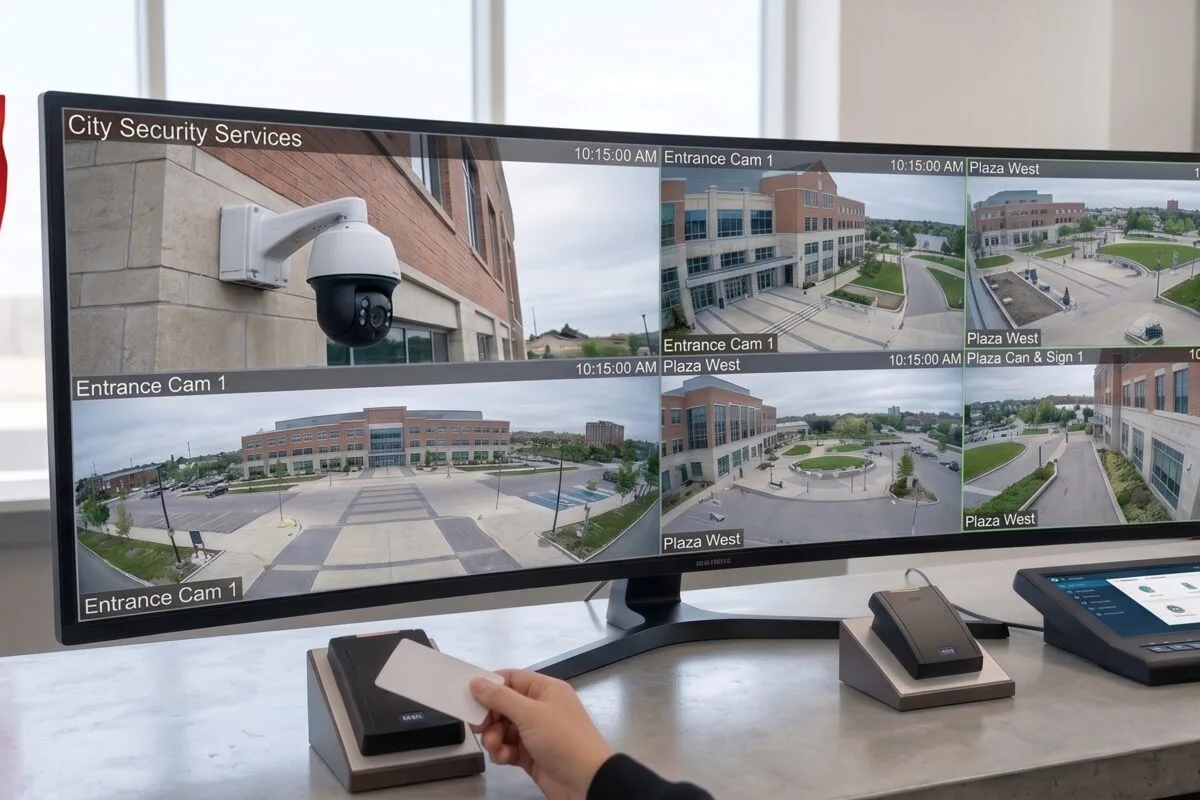
Most municipal facilities departments manage dozens of buildings across multiple sites — with no unified view of who accessed what, when. Our multi-site platform gives facilities directors a single dashboard for all cameras, all access logs, and all alerts across every facility — from the town hall to the public works depot.
All facilities secured in a phased rollout
Facilities Assessment & Priority Map
We assess your highest-risk facilities first — public works yards, overnight storage, civic buildings with after-hours incidents. We map current camera coverage, access control gaps, and identify the quickest wins for your capital budget.
System Installation & Integration
4K cameras, card access control, and motion-triggered perimeter alerts installed at each facility. All systems connect to a single management platform. Existing infrastructure integrated where possible to reduce costs.
Multi-Site Monitoring & Reporting
Facilities staff access all buildings from one login. After-hours alerts on motion, door access, or perimeter breach. Monthly incident and access reports available for council and insurance reporting. System scales as new facilities are added.
Complete municipal facility protection
Multi-Site Camera Management
All cameras across all facilities accessible from one platform. Search footage by date, time, camera, and location. Export clips for police, insurance, or internal investigations. No per-site logins or separate systems to manage.
Access Control & Audit Trail
Card or fob access on every controlled entry point. Revoke credentials instantly when an employee leaves or a key is compromised. Full audit trail of every access event at every facility — available for HR, legal, or council reporting.
Public Works Yard Protection
Perimeter cameras, motion alerts, and after-hours intrusion monitoring for outdoor storage areas. Fuel storage access-controlled and logged. Equipment yards covered with PTZ cameras that track movement across large open areas.
After-Hours Monitoring
Live operators monitor your highest-risk facilities after close. Any unauthorized access or perimeter breach is verified by an operator on the live feed before police are called, which keeps false dispatches off your record. Incident documentation ready for council or insurance reporting within minutes.
Insurance & Compliance Documentation
Every system includes installation documentation, monitoring certificates, and incident reports formatted for municipal insurance submissions. Most municipalities see 15–20% premium reduction after system installation.
Scalable Across All Facilities
Start with highest-risk sites; add facilities on your capital budget timeline. All new sites connect to the same management platform. Adding a new building is a configuration update — not a new system purchase.
Client Results
What municipal government security clients say
“Our transit shelters were being vandalized every few weeks — $3,000–$8,000 per incident in cleanup and replacement. Riowell set up cameras on the three highest-incident locations first. Vandalism at those sites dropped to zero within six weeks. We're now expanding to all 12 shelter locations.”
“Council chambers needed to meet new accessibility and security guidelines before the public gallery reopened. Riowell handled camera placement to avoid ADA sightline conflicts and gave us footage retention on a compliant server. We passed the regional audit with zero findings.”
“A public works yard had a repeat issue with after-hours equipment use by non-authorized staff. Riowell installed card access on the equipment shed and timestamped camera coverage of the yard. Two violations were documented and handled through HR. The issue is resolved and we now have an audit trail for every piece of equipment.”
“We had three fuel theft incidents at our public works depot in less than a year — combined loss over $14,000. After Riowell installed perimeter cameras and access-controlled fuel storage, we've had zero incidents and our insurance broker reduced our municipal property premium by 17%. The multi-site dashboard means our facilities director can check any building from his office.”
Every facility.
One dashboard. Full visibility.
Book a facilities assessment. We'll map your highest-risk sites, design a phased rollout that fits your capital budget, and have your facilities team monitoring all buildings from one platform.
Security for Municipal Buildings beyond Oshawa
We cover Oshawa and 14 other Southern Ontario communities. Every location gets the same technicians, the same equipment, and the same response commitment — pick yours below.
Related properties we protect
Frequently Asked Questions
Ready to secure
your business?
Book a free on-site assessment. We'll evaluate your property and design a custom security and IT solution — no pressure, no commitment.