Stop cargo theft
before it happens.
Ontario recorded 1,601 cargo thefts in 2025 — almost double the prior year. Peel Region is the #1 hotspot. We install live-monitored camera systems for trucking and logistics yards that interrupt incidents while they are happening, not the next morning.
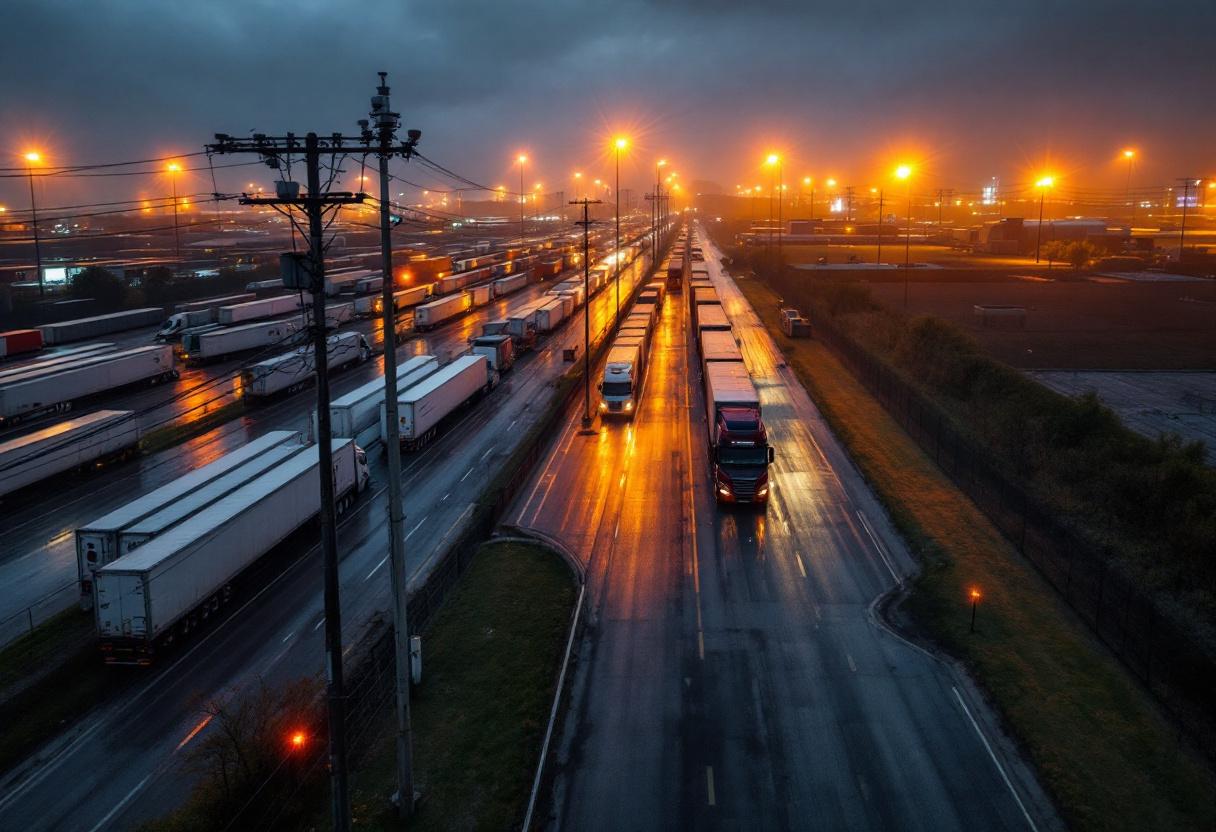
You already know the yard is exposed. The argument is about what to do.
Nobody running a yard needs convincing that overnight is the problem. What is actually hard is deciding what to spend, justifying it to someone who has not stood in the yard at 5 AM, and not being the person who picked the system that failed.
Usually read by: Yard operator / fleet safety manager / dispatch
The yard operator
- Your day
- You are the first one in and you find out what happened overnight by walking the rows. Gate codes, seal checks, trailer swaps, drivers arriving early and parking where they feel like it, and a fence that has been cut and patched more than once.
- What you're judged on
- That a load goes missing on your watch and the honest answer to "how did they get in" is that nobody knows. You can live with a loss. You cannot live with not being able to say what happened.
The fleet safety or compliance manager
- Your day
- You are carrying insurance renewals, customer security questionnaires and the paperwork that follows any incident. Shippers increasingly ask what your yard security actually is before they hand you freight.
- What you're judged on
- Being asked to produce evidence — footage, access records, an incident timeline — and having to admit the cameras were recording but nobody can find the clip, or the retention window already rolled over.
Dispatch
- Your day
- You are the number drivers call, at any hour, about a gate that will not open, a trailer that is not where the board says it is, or a vehicle sitting at the fence line that should not be there.
- What you're judged on
- Being the one who has to decide, at 2 AM with no eyes on the yard, whether to send someone out, call police, or wait until morning and hope.
When the fence gets cut, who does the phone actually ring for?
On most yards the honest answer is the owner, then dispatch, then nobody — because the person who could confirm whether it matters is asleep and the only way to check is to drive in. With live monitoring, the first response happens before that call: an operator is already watching, has issued an audio warning, and either the intruder has left or police have been called with a live description. The call you get afterwards is a report of what happened, not a question you have to answer half-awake.
Same protocol whether the site is in Brampton or anywhere else we cover.
The things people in your position actually ask us
“We already have cameras. Why would monitoring change anything?”
Recording tells you what you lost. Monitoring is about interrupting it while it is happening. If your cameras have ever produced footage you could not do anything useful with, that gap is the whole difference — and it is worth saying plainly that if your existing cameras are well-placed and the resolution holds up at the fence line, we would rather monitor those than sell you new ones.
“Our yard is huge and half of it has no power or network.”
Common, and it shapes the design more than the acreage does. Perimeter and gate coverage usually run on cabled positions near the building; far corners and back fence lines are where cellular units or a trailer earn their place. We map power and signal at survey, not after, because discovering there is no usable feed at the back fence on install day is what turns a one-day job into three.
“Drivers are in and out all night. Won't this be constant false alarms?”
It would be, on a motion-only setup. The design work is in the zones and the schedule — which areas are legitimately busy at 3 AM, which should be empty, and what a normal driver movement looks like versus somebody walking the trailer line on foot. Operators are briefed on your patterns, so a driver doing a pre-trip is not treated the same as a person testing door seals.
“Can we watch only the overnight hours instead of paying for 24/7?”
Yes, and for most yards that is the right call. Your daytime exposure is usually covered by the simple fact that people are there. Paying to have operators watch an active yard at 11 AM rarely earns its keep, and we will say so rather than quote you the bigger number.
“What happens when a load actually goes missing — what do I get?”
An incident package: the clip, a timeline, the entry and exit points, and any plate or description the operator captured, in a form you can hand to police and to your insurer without editing it. The practical value is usually less about recovery and more about the claim and the customer conversation going quickly instead of dragging.
“How do I justify this to an owner who has never been here at 5 AM?”
Usually with the numbers they already have: what the last incident cost once you include the load, the downtime, the deductible and the customer relationship. We will put the coverage design and the cost in writing so the comparison is concrete. If the honest answer is that your exposure does not justify monitoring yet, a well-designed camera and alarm setup is a legitimate place to start.
Most thefts happen while you're sleeping
85% of trucking yard thefts occur between 11 PM and 5 AM. Thieves know when cameras are recording and nobody is watching. A DVR in your office does nothing to stop them — it only helps you file the police report after the fact.
The difference between recording and monitoring is the difference between documenting a theft and preventing one. Our live operators are the difference.
In Brampton, trucking and logistics yards face the same overnight cargo-theft pressure seen across the GTA — with local police reporting rising intrusions on Peel Region industrial corridors. Our live operators are watching Brampton yards before thieves have time to cut a fence.
Case Study — Mississauga Yard
3-acre trucking yard, 16 cameras, live monitoring from 8 PM to 6 AM. Three intrusion attempts in the first month — all stopped via two-way audio. Zero cargo theft in 12 months. System cost: $48K. Prior annual losses: $220K.
High-Risk Zones in Ontario
Trucking Yard Security in Brampton — what we actually see.
Brampton's truck-yard theft pattern is driven by volume and density. Goreway Drive, Steeles Avenue, Walker Drive, Bramalea Road, and the Highway 7 commercial belt form one of the largest owner-operator yard clusters in Ontario. LTL terminals, Amazon and FedEx sort facilities, and hundreds of independent owner-operators stage freight within a few kilometres of each other — which means a single theft ring can run a scouting circuit touching six or eight yards in one drive. Peel Regional Police ran multiple targeted cargo-theft enforcement operations across Brampton between 2023 and 2025, and cargo theft in the area still climbed year-over-year. What enforcement can't fix is the 3 AM window between the last log entry and the morning dispatcher. That's when yards without live monitoring lose trailers. The independent operators we onboard in Brampton almost always describe the same discovery: driver arrives at 5:30 AM, trailer is gone, DVR footage shows the hitch happening at 2:47 AM.
Goreway/Steeles corridor density
Yard after yard along Goreway and the Bramalea/Steeles junction means a thief can scout four properties in a single loop. We track vehicle patterns across our Brampton client base and flag repeat surveillance behaviour before an attempt happens.
Independent owner-operator risk
Most Brampton lots are single-owner yards with no on-site guard, no overnight staff, and no budget for a full security team. Live video monitoring with audio talk-down is the only 24/7 deterrent available under $4K/month — and it performs better than most guard contracts.
Catalytic and reefer battery theft
Beyond trailer theft, Brampton yards see persistent catalytic-converter and reefer battery incidents targeting the parked units in independent lots. Motion-triggered live operator review intercepts these during the loadout, not in the morning log.
Police Coordination — Brampton
Peel Regional Police 21 Division covers Brampton's industrial north and east; 22 Division covers central and south Brampton yards. We register gate access codes with the correct division before monitoring goes live, so officers aren't stuck at a locked gate during a real-time callout.
Client Story — Brampton
LTL terminal, Goreway Drive — 10 months under monitoring
1.8-acre independent LTL staging yard, no on-site guard, 30–40 trailers in nightly rotation. Prior year: one confirmed hitch-and-run (trailer + high-value electronics, $215K loss), two catalytic-converter incidents. We installed 12 cameras — perimeter, trailer aisles, and gate. Live monitoring, 10 PM to 6 AM. In 10 months under monitoring: three intrusion attempts, all intercepted via audio talk-down before contact with any trailer. One Peel Police dispatch resulted in an arrest. Zero cargo losses. Monthly monitoring cost: $1,340. Prior year insurance deductible from the hitch: $25,000.

Live Video Monitoring
Recording is not monitoring.
Watching is.
Every Ontario trucking yard already has cameras. Most have been robbed anyway. The camera caught it on video — after the truck, trailer, and cargo were gone. Live monitoring stops the incident before it starts.
Secure yard in under 2 weeks
Free Yard Assessment
We walk your yard and map every blind spot — entry gates, trailer rows, loading docks, fuel bays. We identify the exact camera positions and monitoring windows that eliminate coverage gaps.
Camera Installation & Setup
Our technicians install PTZ and fixed 4K cameras on poles, buildings, and perimeter fences. Weatherproof, tamper-resistant hardware rated for Canadian winters. Live feed active within 24 hours.
Live Monitoring — Every Night
Human operators watch your yard overnight. When an intruder enters, they issue a two-way audio warning. If the threat continues, the operator calls police while watching — usually before anything is touched.
Everything your yard needs in one system
4K PTZ Cameras
Pan-tilt-zoom cameras that cover your entire yard without blind spots. Remote operators zoom in on license plates, faces, and cargo details in real time.
Live Human Monitoring
Not just recording — watching. Our remote operators monitor your yard during your highest-risk hours. Typically 8 PM to 6 AM, when 85% of yard thefts occur.
Two-Way Audio Deterrence
Speakers mounted at your entry points let our operators speak directly to intruders. Over 90% of incidents end at the verbal warning — no damage, no theft, no police report.
Licence Plate Capture
Dedicated ANPR cameras at gate entry and exit record every plate 24/7. Invaluable for insurance claims, police investigations, and unauthorized access tracking.
Insurance Premium Reduction
Professionally monitored camera systems typically reduce commercial insurance premiums by 15–20%. One prevented $202K theft pays for 4+ years of monitoring.
Gate Access Control
Secure your yard perimeter with card or fob-controlled vehicle gates. Combined with cameras, you know exactly who entered your yard and when — and have video to match every event.
Client Results
What trucking yard security clients say
“After two tailgate thefts and a missing pallet we brought Riowell in to cover the back lanes at our Brampton yard. They had 12 cameras up within three days. We share the footage link with our insurance rep every quarter — and our premium dropped $8,400 last renewal.”
“The GPS and camera combo gave us real accountability at the gate. Drivers know everything is recorded from entry to departure. Claims of missing freight dropped from four per month to one in the last six months.”
“A copper cable theft cost us $22,000 in repairs and three days of downtime. Riowell installed PTZ cameras on the perimeter and tied in monitoring. Since then they've called us twice at 3 AM when someone was testing the fence — no incidents have materialized.”
“We were losing $15,000–$30,000 a month in cargo from our Brampton yard. After Riowell installed 14 cameras with live monitoring, we had zero incidents in the first six months. The system paid for itself in week three.”
Protect your yard tonight.
Start with a free assessment.
We'll walk your property, identify every coverage gap, and design a live-monitored camera system that stops cargo theft before it costs you $200,000. Free, no commitment.
$0 upfront. 90-day guarantee. 8 spots this year.
See the full offer stack: $2,500/month live monitoring, military-grade night vision, insurance documentation, and a verified call to police rather than an unconfirmed alarm. No long-term contract.
Security for Trucking Yards beyond Brampton
We cover Brampton and 14 other Southern Ontario communities. Every location gets the same technicians, the same equipment, and the same response commitment — pick yours below.
Related properties we protect
Frequently Asked Questions
Ready to secure
your business?
Book a free on-site assessment. We'll evaluate your property and design a custom security and IT solution — no pressure, no commitment.