Every property secured.
One dashboard.
Managing security across 5, 10, or 20 properties shouldn't mean 10 different systems, 10 different vendors, and 10 different logins. We build a unified camera and access control platform that gives Ontario property managers full portfolio visibility — and a single point of contact when something goes wrong.
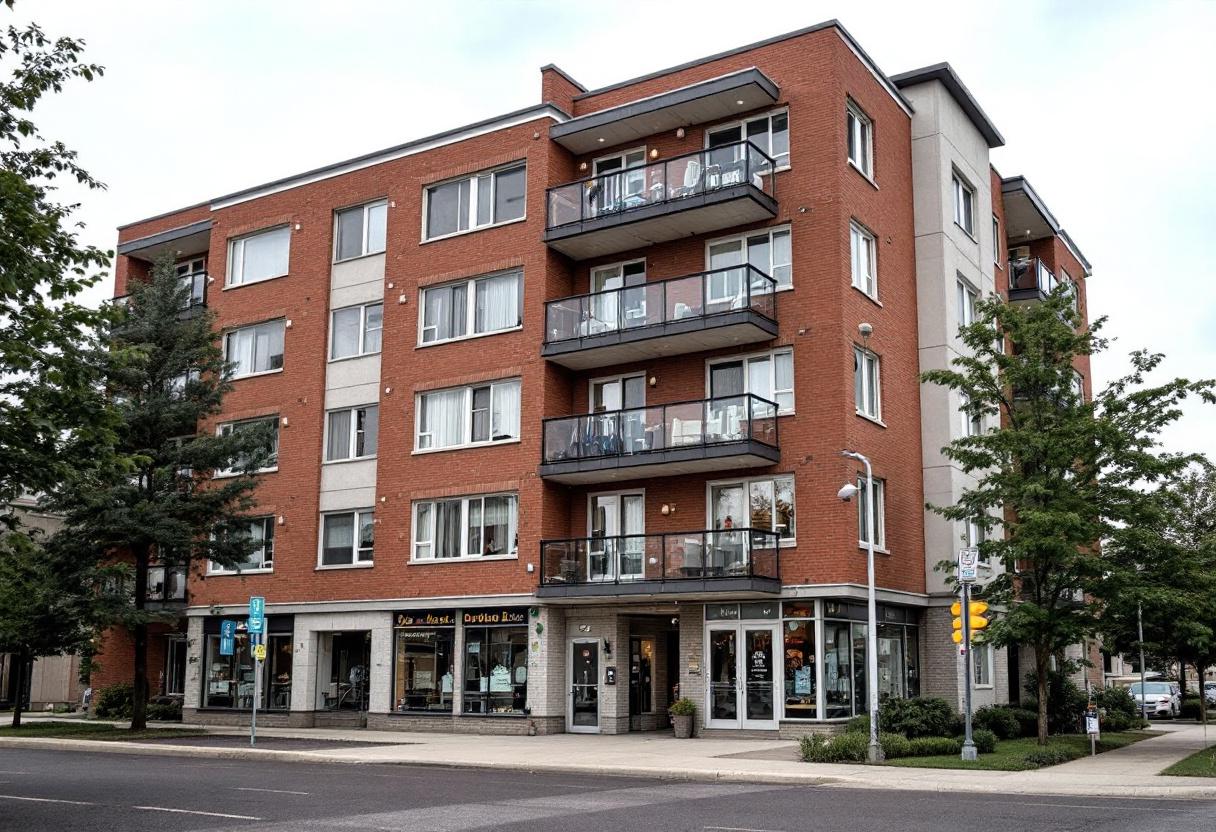
You did not choose any of these systems.
Portfolios are assembled, not designed. Every building arrived with the vendor the previous manager signed, the recorder the previous owner bought, and a superintendent whose memory is the only index of what is where. The work is not installing cameras. It is untangling twelve of those inheritances without stopping the day job.
Usually read by: Property manager / portfolio manager / real estate company
The site property manager
- Your day
- You have two or three buildings and a phone that does not stop. A garage door that has not fully closed in a month, an amenity room booked by a tenant whose guests stayed until two, a contractor who needs the mechanical penthouse on Thursday, and a tenant asking you for footage of the visitor parking spot beside theirs.
- What you're judged on
- Being the one who says "I will look into it" and then cannot. The recorder at that site is either full, offline, or behind a password held by a contractor who stopped answering two years ago, and every hour that answer is missing is an hour the tenant's complaint escalates upward.
The portfolio or regional manager
- Your day
- You are looking across a dozen or more properties on a spreadsheet of contracts, renewal dates and service calls. You approve invoices for monitoring at sites you have never walked, and you are the one who notices a line item that has been renewing for a system that was removed during a retrofit.
- What you're judged on
- Owner reporting and vendor sprawl. You are asked for a portfolio-level answer — what is our coverage, what is our retention, what is our exposure — and assembling it means eleven phone calls to eleven vendors, each of whom only knows their own site.
The owner's representative at the real estate company
- Your day
- You act for the capital behind the buildings. You read variance reports, sign off on capital items, and field the owner's question after an incident makes it into a tenant's email chain.
- What you're judged on
- Liability and consistency. One badly documented incident at one site becomes a file that involves counsel and an insurer, and the question that follows is always whether the same gap exists at the other nineteen properties. You need an answer that covers the portfolio, not an answer about one garage.
It is 3 AM at the property you inherited last quarter. Who picks up?
The realistic chain is the superintendent's personal mobile, then the site manager's personal mobile, then whichever number is taped inside the site office — and at least one of those numbers belongs to a vendor whose contract at that address has lapsed. The person who eventually answers has no camera view of the property and no way to check anything without driving there. Putting the portfolio behind one monitoring arrangement changes the order: the event is verified by an operator who can see the site, the site manager is contacted only if there is something to act on, and the same escalation path applies at every address regardless of which vendor originally wired it. The difference your managers feel first is not the technology — it is that they stop being the first line at three in the morning.
Same protocol whether the site is in Brampton or anywhere else we cover.
The things people in your position actually ask us
“Every building came with its own vendor and contract. Untangling that is the project I keep postponing.”
So we start with the untangling rather than the buying. The first deliverable is an inventory: what is installed at each address, what it actually records, what the retention really is once you check rather than assume, which monitoring contracts are live, what they cost, and when each one can be exited. Several managers have found sites paying for monitoring on hardware that was removed years earlier. That document has value even if you never install a single camera with us.
“We might lose the management contract on two of these buildings next year.”
Then those two should not be at the front of the rollout, and the agreement should not assume they will be there. We scope per property so a site can come off the platform without unwinding the rest, and we prioritize the buildings where your contract is long and the incident history is real. Standardizing works in your favour precisely because it is not tied to any one address staying in the portfolio.
“If we lose a site, who owns the footage and the account?”
The property does, and that needs to be written down before the first install, not negotiated during a transition. Recorded footage and access logs belong to the ownership of that building, exports are available on request, and account administration transfers with the property. We would rather be explicit about this than have you discover the answer the way you discovered it with the last vendor.
“Our superintendents are not going to learn new software.”
Then the design has failed if it needs them to. What a super actually needs is a saved view of their own property, a search by date and door, and an export button — which is roughly the number of steps in the tools they already avoid. Head office roles get the portfolio view. We train on site, in the site office, on the two tasks each person genuinely performs, and we do not hand anyone a manual for functions their role will never touch.
“Do we have to rip out twenty properties at once?”
No, and we would argue against it. Where a site has a healthy recorder with usable coverage and three years of life in it, leave it running and bring it onto the dashboard at its natural renewal. The rollout should follow risk and contract dates, not a wish for a uniform install date. A portfolio standardized over three budget years is a normal outcome, and it is a great deal easier to approve.
“Two of our sites are third-party managed for owners who will not spend a dollar.”
Then the deliverable for those sites is documentation, not hardware. We put the coverage gap in writing, you put it in front of the owner once, and the file shows what was recommended and when. If the owner still declines, you have transferred the decision to the person entitled to make it, which is materially better for you than carrying an undocumented gap on a property you do not control.
You find out from the tenant, not from the system.
Across ten or twenty properties, nothing fails the same way twice. One garage door has not closed fully for a month. One recorder stopped writing in the spring and nobody noticed because nobody had a reason to pull footage until now. One site has a monitoring contract that renewed automatically for a system that was decommissioned. The pattern is not negligence — it is that every building was inherited with its own vendor, its own login, and its own superintendent's memory as the only index.
The cost shows up when someone asks you to prove what happened. An owner wants an incident summary, an insurer wants the retention period, a tenant's lawyer wants the clip. Reconstructing that from a decade-old DVR whose password left with a previous contractor is where a manageable incident turns into a liability file.
In Brampton, property management companies oversee a mix of residential and commercial assets across the Peel Region region — each with its own security exposure. Our unified platform gives Brampton property managers full visibility and centralized control across every property in their portfolio.
Case Study — Mixed residential and commercial portfolio, GTA
A property management firm brought us in after a garage break-in at one site turned into a tenant complaint they could not answer. We audited all of their buildings before quoting anything. Several recorders were offline or overwriting well short of the retention the leases implied, two sites were paying for monitoring on hardware that no longer existed, and no site had a reconciled master-key or fob list. We consolidated onto one platform, onboarded the highest-risk buildings first, and set contractor access to time-limited codes scoped to a single door. The firm now answers an owner or insurer request the same day, and the after-hours calls that used to reach a manager's personal phone reach an operator first.
Recurring Weak Points Across a Portfolio
Property Management Security in Brampton — what we actually see.
Brampton property management portfolios reflect the city's dual character: rapidly intensifying condo development in the downtown and suburban nodes, and a large inventory of older working-class rental stock in Bramalea, Springdale, and along Kennedy and Steeles. PM companies managing Brampton portfolios often face a wider variance in building quality and incident rate than anywhere else in the GTA — a new condo in downtown Brampton may be on one end, while a 1980s Bramalea rental with aging infrastructure and high complaint volume is on the other. The common thread is that many Brampton PM portfolios have grown through acquisition and now carry a patchwork of legacy security systems from different eras. Peel Regional Police report high commercial and residential incident rates across Brampton — PM companies with no portfolio-wide monitoring are absorbing incident costs across multiple buildings with no unified visibility.
Bramalea and older rental portfolio risk
Bramalea and central Brampton rental buildings carry the highest per-building incident rates in many PM portfolios. These are the properties where a portfolio-wide upgrade rollout should start — the incident density here means the fastest ROI on security investment.
Mixed new-and-old portfolio management
Brampton PM companies managing both new downtown condos and aging suburban rentals need a system that works for both building types — from builder-spec camera integration for newer builds to full hardware replacement for 1990s-era analog systems. One platform handles both.
Peel Region insurance portfolio requirements
Peel Regional insurers have tightened security documentation requirements for multi-unit residential portfolios since 2023. One portfolio-level submission — monitoring certificates and camera documentation across all Brampton properties — is what insurers are asking for. Managing this per-property across multiple vendors is unsustainable.
Police Coordination — Brampton
Peel Regional Police 21 Division covers central and north Brampton; 22 Division covers south Brampton and downtown. We register each portfolio property with the correct Peel division and maintain current access protocols — so Peel dispatch has building entry information ready for any property in your portfolio when an incident call is generated.
Client Story — Brampton
9-property residential portfolio, Brampton — high-incident portfolio priority upgrade
Property management company, 9 residential buildings: 3 older Bramalea rentals (72–140 units), 4 suburban townhouse complexes, 2 new downtown Brampton condos. Annual documented security incidents across portfolio: 44 package theft complaints, 12 parking vehicle incidents, 8 lobby access complaints. No unified monitoring. We prioritized the 3 Bramalea rentals (highest incident density), upgrading cameras and activating monitoring within 6 weeks. Rolled out to remaining 6 properties over 14 weeks. All 9 on one dashboard. Portfolio-wide incident complaints dropped 78% in 10 months. Insurance renewal documentation delivered as a single submission — premium held flat against market increases.
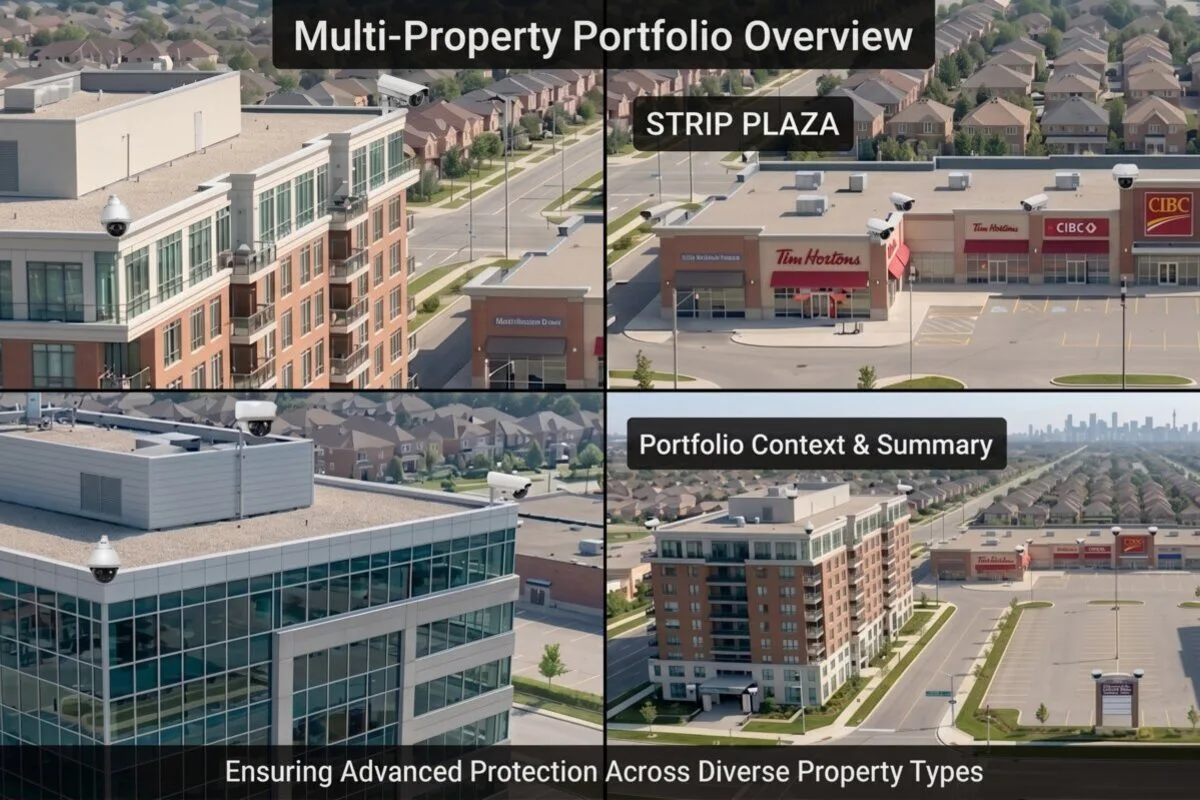
Portfolio-Wide Visibility
10 properties, 10 vendors
is 10 problems.
Most property management companies inherit a patchwork of legacy camera systems, expired monitoring contracts, and access control that nobody can manage centrally. We replace it with a single platform — same cameras, same software, same dashboard — across your entire portfolio.
Your full portfolio on one platform
Portfolio Security Audit
We assess every property — existing cameras, access control, monitoring contracts, and coverage gaps. We deliver a written report showing what's working, what's expired, and what's exposing you to liability. Most property managers find gaps they didn't know existed.
Unified System Rollout
We standardize on one camera platform and one access system across your entire portfolio. Properties are onboarded in order of risk priority. All sites go onto the same dashboard and management app — no more juggling multiple logins or vendors.
Centralized Monitoring & Support
One monitoring team covers all your properties. One phone number when you need support. Monthly reporting across your portfolio. When a tenant reports an incident, your team pulls footage from any property in under two minutes.
Everything your portfolio needs in one system
Unified Multi-Site Dashboard
View every camera at every property from one app. Switch between sites instantly. Filter by property, camera type, or alert status. Your whole portfolio visible in one pane of glass — on any device.
Standardized Camera Platform
The same 4K camera system installed at every property in your portfolio. No mismatched hardware, no compatibility issues, no different software per site. One system to learn, manage, and support.
Portfolio-Wide Access Control
Manage tenant and contractor access across all properties from one platform. Grant, restrict, and revoke access remotely. Temporary codes for maintenance — automatically expire. Full audit trail per property.
Tenant Safety Reporting
When a tenant reports an incident, pull footage from the relevant camera in under two minutes. Export the clip, share with police, and close the complaint the same day. Tenant retention improves when safety concerns are resolved fast.
Insurance Documentation
One system report covers your entire portfolio for insurance renewals. Monitoring certificates, installation specs, and incident logs — all in one place. Most clients reduce commercial premiums by 15–20% across the portfolio.
Single Vendor, Single Contact
One account manager, one monitoring team, one support line — for your entire portfolio. No more tracking down 5 different vendors when something breaks. If it's on our platform, we own it.
Client Results
What property management security clients say
“We manage 14 properties across Peel and York Region. Before Riowell, every incident meant physically going to the site. Now I can pull footage remotely and often resolve tenant disputes before I've even left my office.”
“Three of our buildings had chronic vandalism in the underground parking. Riowell added cameras to the blind spots and set up motion alerts after midnight. Two weeks in, they called us at 1 AM — someone was spray-painting. Trespass notice issued. It hasn't happened since.”
“Our insurance renewal required upgraded surveillance documentation. Riowell did the full survey, installed the system, and gave us a complete coverage report for the underwriter. We renewed without issues and our premium held steady — when every comparable building in our market saw increases.”
“We manage 14 residential and commercial properties across the GTA. We had four different camera vendors, two monitoring companies, and a stack of contracts nobody could keep track of. Riowell replaced all of it — standardized cameras, one dashboard, one monitoring contract. Our team responds to tenant incidents in minutes instead of days. We also saved $22,000 on our annual insurance renewal.”
One platform.
Every property secured.
Book a portfolio assessment. We'll audit your current systems, identify gaps and redundancies, and show you exactly what a unified security platform would save you — in cost, time, and liability.
Security for Property Management beyond Brampton
We cover Brampton and 14 other Southern Ontario communities. Every location gets the same technicians, the same equipment, and the same response commitment — pick yours below.
Related properties we protect
Frequently Asked Questions
Ready to secure
your business?
Book a free on-site assessment. We'll evaluate your property and design a custom security and IT solution — no pressure, no commitment.