Sacred spaces deserve
real protection.
Police-reported hate crimes targeting religious institutions in Canada rose 73% between 2019 and 2023 — with Ontario accounting for the largest share. Places of worship face a dual threat: ideologically motivated vandalism and after-hours property crime. We install discreet, effective camera and access systems that protect your congregation without changing the character of your space.
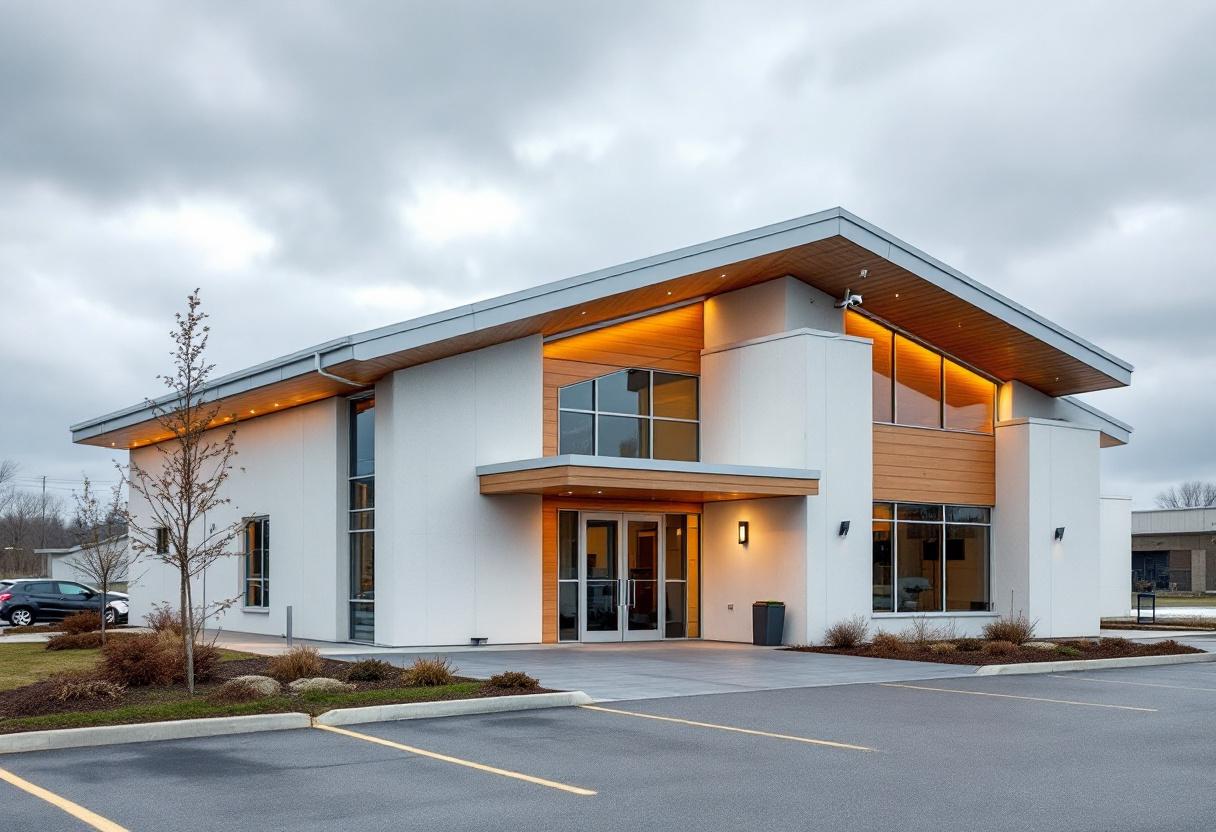
The doors are supposed to be open.
Almost nobody making this decision does security for a living. It is a trustee who volunteered, a committee that meets once a month, and a faith leader who does not want the building to feel guarded. The real tension is not cost — it is that every control you add is in some tension with being a place anyone can walk into.
Usually read by: Board / trustee / facilities committee / pastor
The volunteer on the property or facilities committee
- Your day
- You are the one who comes in on a Saturday to meet the roofer, who noticed the spray paint on the east wall before anyone else, and who has been asked to bring three quotes to the next meeting. You do this around a job and a family, and the building has a boiler, a parking lot and a hall rental schedule that all compete for your attention.
- What you're judged on
- Bringing a recommendation to people who trust you and cannot evaluate it themselves. You are wary of being sold something, wary of spending donated money badly, and aware that if the building is hit again after the committee deferred, the deferral was partly yours.
The faith leader
- Your day
- You are in the building more than anyone, often alone in the evening, and you are the one people come to when they are in distress — sometimes at the door, unannounced, after hours. You know which members are anxious about incidents in the news and which are uneasy about the idea of cameras.
- What you're judged on
- Holding both at once. You are responsible for the safety of people in your care and for the character of the space, and you do not want the answer to the first to be a building that visibly distrusts everyone who approaches it.
The administrator or office volunteer
- Your day
- You hold the schedule, the hall bookings, the key cabinet and the list of who has a key — which is longer than anyone believes and includes people who moved away. You open for the cleaner, the food programme, the youth group and the contractor, and you are usually the last one to lock the sanctuary doors.
- What you're judged on
- Being the person the keys trace back to. When something goes missing from the office or the donation box, the question is who had access, and the current answer at most congregations is a key ring that has been copied an unknown number of times over twenty years.
Somebody is in the parking lot at 2 AM. Who does the alarm reach?
Usually the faith leader, then a trustee, then nobody — and the person who answers is expected to decide, half-awake and alone, whether to drive over and walk the grounds themselves. That is the part we would most like to take off a volunteer, because it is the one arrangement in this whole conversation that puts a person at actual risk. With after-hours monitoring on the exterior, the decision is made by someone who can see the lot: an audio warning goes out, most people leave at that point, and police are called with a description if they do not. Either way the congregation finds out in the morning from a report with a clip rather than from paint on the wall, and nobody had to go stand in the parking lot at two in the morning to find out.
Same protocol whether the site is in Hamilton or anywhere else we cover.
The things people in your position actually ask us
“We are meant to be open. We are not going to lock the front door during services.”
Nor should you, and no good design asks you to. The controls belong on the hours and the doors where nobody is watching — exterior coverage overnight, the office corridor, the side and rear entrances, the hall when it is rented. During services the sanctuary entrance stays as it is. If a proposal starts by restricting the times your building is full of people, it is solving the wrong problem.
“Our committee meets once a month and nothing is decided in one sitting.”
That is normal for us and we plan around it. The assessment and the written report are free and yours to keep, and they are designed to be read by people who were not on the walkthrough — where the exposure is, what each part would cost, and what the sequence would be if you did it in stages. Take as many meetings as you need. We would rather be the quote that is still standing in three months than the one that pushed for a decision in the room.
“We run on donations. A monthly monitoring bill is hard to justify to the congregation.”
Then start without it. Cameras, lighting and better door hardware are a one-time cost and they do most of the work against the overnight vandalism that hits exterior walls and signage. Monitoring is worth adding when there is a pattern of repeat incidents or when the building sits empty for long stretches. We will scope it as a separate decision rather than bundling it, and we will not quote you monitoring for hours when two hundred people are in the building.
“There are keys to this building all over the community and we do not know how many.”
That is the most common finding we have at places of worship, and it is fixable without a confrontation. The usual approach is to change the cylinders on the doors that matter — office, sanctuary, hall, mechanical — and reissue on a coded credential that can be turned off one person at a time when someone steps away from a role. Nobody has to be accused of anything; the system simply stops depending on keys coming back.
“We were told there may be a grant. Should we wait for it before doing anything?”
Get the assessment done either way, because a written scope with costs is usually what an application needs. Whether a particular programme is open, what it covers and what it requires from your organization changes, so we will help you assemble documentation and we will tell you what we do not know rather than promising an outcome. Where there is a real risk of waiting a year, we will show you which one or two items are worth doing now out of your own funds.
“We run a food programme and a drop-in. People come here when they have nowhere else to go.”
Then say so at the survey, because it changes the design. Cameras pointed at the door of a programme where people arrive at their lowest point cost you more in trust than they return. Coverage belongs on the exterior walls, the parking lot, the office and the storage areas, with signage that explains what is covered. The part of the building where people are served is where you want a volunteer who knows them, not a lens.
Hate crimes against religion are rising.
Statistics Canada's 2023 hate crime report found that religious institutions are the most targeted category of hate crime in Canada — ahead of race, sexual orientation, and all other categories. Ontario accounts for the largest share of national incidents. The targets span all faiths: synagogues, mosques, churches, gurdwaras, and temples have all reported incidents in recent years.
Places of worship face a second threat that has nothing to do with hate: opportunistic property crime. An open, trusting congregation with predictable weekly schedules and minimal overnight security is an easy target for after-hours break-ins targeting AV equipment, musical instruments, office electronics, and cash from donation boxes.
In Hamilton, places of worship face the same rising threat of hate-motivated vandalism and after-hours property crime seen across the Hamilton-Wentworth region. Our discreet camera and monitoring systems give Hamilton congregations effective protection — and documentation for federal Security Infrastructure Program grant applications.
Case Study — GTA Mosque
Two vandalism incidents in three months — exterior walls and signage targeted. Congregation was hesitant about visible security cameras. Riowell installed discreet dome cameras covering all entry points and the parking lot, with covert positioning that preserved the building's character. Zero incidents in the following 14 months. System documentation submitted to the federal Security Infrastructure Program for partial reimbursement.
High-Risk Areas in Places of Worship
Place of Worship Security in Hamilton — what we actually see.
Hamilton's place-of-worship security landscape reflects the city's complex mix of long-established faith communities and newer immigrant congregations. The city's historic downtown churches — Central Presbyterian, Christ's Church Cathedral, and several Anglican and United church buildings in the King Street and James Street corridors — are significant heritage properties that face both tourism and after-hours property crime. Hamilton's growing Muslim community has established mosques in the Mountain area and central Hamilton, with documented incidents including exterior vandalism and threatening communications. The city's Sikh and Hindu communities, concentrated in the east Hamilton and Stoney Creek areas, have experienced incidents at community cultural centres that serve a dual religious-and-cultural function. After-hours break-ins targeting AV equipment, musical instruments, and donation boxes are the most frequently reported non-hate incidents — with the King William Street and Barton Street corridors showing the highest incident concentration. Hamilton's heritage building stock creates specific installation challenges: stone facades, stained glass, and architecturally significant rooflines require careful camera placement that doesn't damage or visually compromise heritage surfaces.
Heritage building installation expertise
Hamilton's significant stock of 19th and early 20th century church buildings — stone, brick, stained glass — requires installation methods that don't penetrate heritage surfaces. Wireless cameras with non-invasive mounting and small-profile dome units at architectural recesses are standard for Hamilton's heritage corridor.
Downtown core crime adjacency
Places of worship in Hamilton's King-James Street and Barton Street corridors sit in the city's highest commercial property crime zone. After-hours break-ins targeting electronics and donation cash follow the same pattern as adjacent commercial break-ins — opportunistic entry through a side door or window with no camera coverage.
Mountain-area Muslim community documentation needs
Hamilton Mountain mosques with documented vandalism or threatening incidents have strong SIP grant qualification evidence. We assist with threat documentation compilation and full application packages for Hamilton congregations.
Police Coordination — Hamilton
Hamilton Police Service handles all religion-motivated incidents and after-hours property crime at places of worship. We coordinate with HPS for incident response and provide footage in the format required for hate-crime investigations. For heritage properties in the downtown core, we pre-register building access information — avoiding any heritage surface damage during a police response to an active alarm.
Client Story — Hamilton
Heritage Anglican church, King Street West — 12 months under monitoring
19th century stone building, stained glass exterior, downtown core location. Prior incidents: two donation-box thefts (forced entry through side vestibule), one attempt to remove copper flashing from the rear elevation. Board required completely non-invasive installation to protect heritage designation. We installed four wireless cameras on non-heritage masonry — no surface penetration — covering the vestibule, side entry, rear elevation, and parking area. After-hours motion alerts to the church warden's phone. In 12 months: one attempted vestibule door entry detected and flagged, Hamilton Police dispatched. No losses. Heritage designation unaffected.
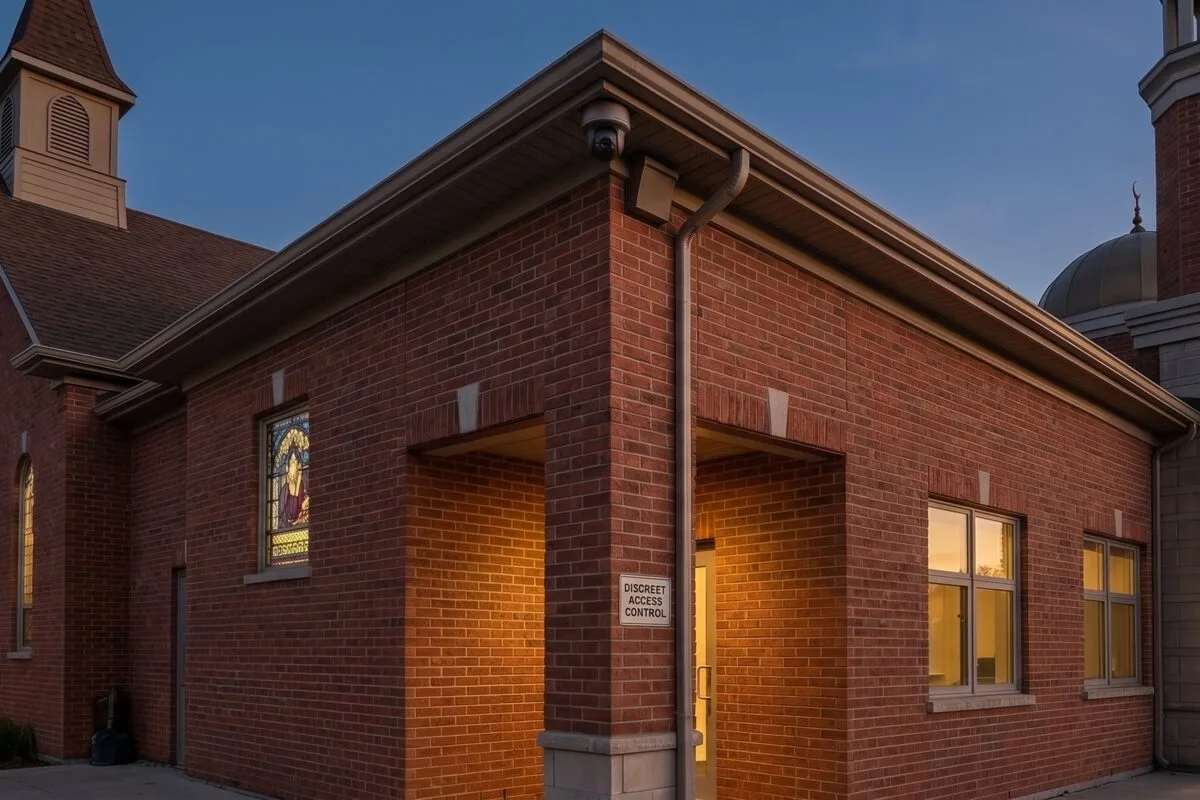
Discreet Installation
Security that protects
without intruding.
Places of worship have a character worth preserving. We design camera placements that provide complete coverage without cluttering the building's appearance — small dome cameras at rooflines, integrated intercom at the entrance, and wireless cameras for exterior coverage that require no conduit runs.
Protected and monitored in under two weeks
Security Walk-Through & Grant Assessment
We walk your full property — exterior walls, entry points, parking lot, and outbuildings — and map the specific risks. We also review your eligibility for the federal Security Infrastructure Program (SIP) grant, which reimburses up to $50,000 of eligible security costs for religious institutions.
Discreet Camera & Access Installation
Exterior cameras positioned to minimize visual impact while covering all entry points and vulnerable surfaces. Intercom-with-camera at the main entrance. Card or fob access for staff-only areas. Installed without damage to heritage surfaces where applicable.
Monitoring & Incident Response
After-hours monitoring for the highest-risk overnight periods. Real-time alerts on perimeter breach or motion. All incidents documented with HD footage, timestamps, and operator notes — ready for police and insurance within minutes. Grant documentation provided post-installation.
Full protection. Discreet installation.
Exterior Coverage for Vandalism Prevention
Cameras covering exterior walls, signage, and building faces are the primary deterrent against hate-motivated vandalism. Visible deterrence alone reduces incidents significantly. When incidents do occur, HD footage provides police with identification-quality evidence.
Parking Lot & Perimeter Monitoring
Cameras covering the parking lot and grounds protect congregation members arriving and departing, deter vehicle vandalism, and monitor the perimeter for after-hours activity. PTZ coverage available for larger properties.
Main Entrance Intercom & Camera
Camera-verified intercom at the main entrance allows staff to see and speak with visitors before allowing entry. Useful during services for managing late arrivals, during office hours for visitor screening, and after hours for security.
After-Hours Monitoring
Live operators monitor your property during the overnight hours when vandalism and break-ins peak. Any perimeter breach or motion event brings a live operator onto the feed within seconds, and police are called only once an intrusion is confirmed. You receive an immediate alert with footage.
Federal Grant Documentation
We prepare the system specification, coverage documentation, and installation certificate required for a Security Infrastructure Program (SIP) grant application. Eligible places of worship can receive up to $50,000 in reimbursement for qualifying security costs.
Heritage & Discreet Installation
We specialize in installations that preserve the appearance of heritage buildings and sacred spaces. Small-profile dome cameras, wireless options to avoid surface penetration, and covert mounting that provides coverage without visible hardware on the building face.
Client Results
What place of worship security clients say
“There was a pattern of cash collection envelopes going missing after services. We were hesitant about cameras — it felt intrusive in a worship space. Riowell designed a system covering administrative areas and exits without intruding on the sanctuary. The issue was resolved within two weeks.”
“We host community events three nights a week with non-members. The lobby and parking lot were concerns. Riowell set up cameras with remote access so our elder on duty can check the lot from inside. We haven't had a car broken into since — it had been happening two or three times a year.”
“We had a vandalism incident targeting our exterior — graffiti and a broken window. Riowell cameras gave police clear footage. The suspect was identified and charged. Our congregation felt protected and the insurance paid out the claim same week based on the footage.”
“After our second vandalism incident in three months, our board voted to install cameras — but we were worried about how they'd look on our 80-year-old building. Riowell used small dome cameras positioned at the roofline and we can barely see them. No incidents in over a year. They also helped us submit the SIP grant application and we were reimbursed for most of the installation cost.”
Protect your congregation.
And your building.
Book a free security assessment. We'll walk your property, identify every vulnerability, and design a discreet system that protects your space — and we'll review your eligibility for the federal Security Infrastructure Program grant.
Up to $50,000 in grant funding available.
The Government of Canada's Security Infrastructure Program reimburses eligible places of worship, cultural institutions, and at-risk communities for qualifying security costs. We prepare the documentation and support your application.
Security for Places of Worship beyond Hamilton
We cover Hamilton and 14 other Southern Ontario communities. Every location gets the same technicians, the same equipment, and the same response commitment — pick yours below.
Related properties we protect
Frequently Asked Questions
Ready to secure
your business?
Book a free on-site assessment. We'll evaluate your property and design a custom security and IT solution — no pressure, no commitment.