Every guest protected.
Every incident documented.
Vehicle break-ins are the most frequent crime at hotel and motel properties — followed by room theft, assault, and vandalism. Over 60% of hotel-related incidents occur within 100 yards of the property during arrival and departure. We install camera, parking lot, and access systems that protect your guests and staff — and give you the footage documentation your insurer and legal team require when incidents happen.
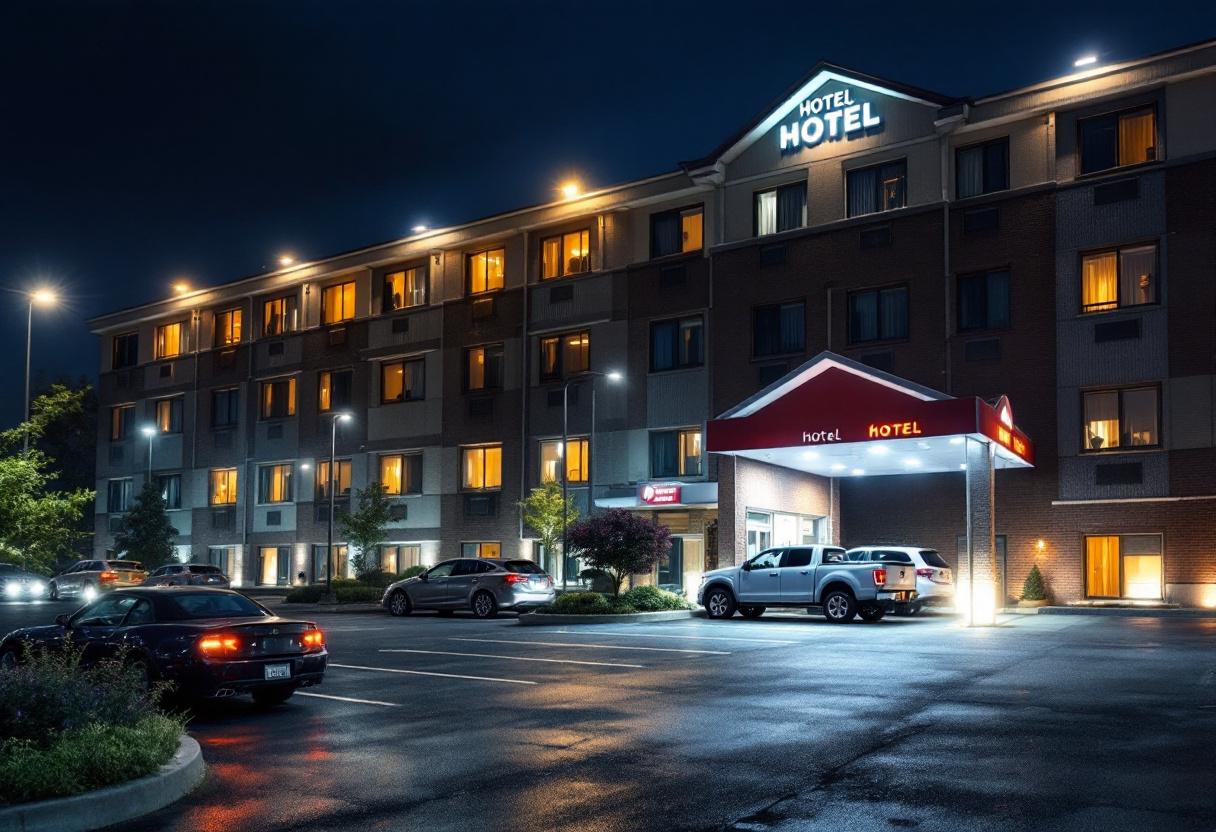
The incident is over in ten minutes. The review lasts for years.
A hotel property never fully closes, so there is no point in the day when the exposure stops. What makes this different from most commercial buildings is that the people on site are guests. An incident in your lot or your corridor becomes your liability, your insurance file, and — often within hours — a paragraph on a booking site that outlives the incident by a long way.
Usually read by: GM / owner-operator / hotel management company
The general manager
- Your day
- You are running occupancy, housekeeping and the front desk, and dealing with whatever came in overnight before the first meeting of the day. A guest reporting a car broken into, a room key that worked when it should not have, a dispute at the desk that started at 1 AM and is still live at 9.
- What you're judged on
- Being asked what happened and having only the guest's account and the night auditor's memory to go on. You are measured on occupancy and review scores, and a single incident you cannot document can affect both at once.
The owner-operator
- Your day
- You own the building and often work in it. You handle the insurance renewal, the capital spend, the lot lighting, and the exterior doors that guests prop open for a smoke and leave open for an hour.
- What you're judged on
- A liability claim you cannot answer. When a guest says something happened on your property and there is no footage either way, the argument tends to settle rather than resolve — and your renewal notices it.
The management company representative
- Your day
- You cover several properties for the owners and you are rarely standing in any of them. You are reading incident reports, comparing properties, and answering to an ownership group about risk exposure across a portfolio.
- What you're judged on
- Inconsistency. One property documents everything, the next produces nothing, and you are the one explaining the difference to an owner who assumed both were handled the same way.
A guest comes to the desk at 3 AM. Who backs up the one person standing there?
On most properties the night auditor is alone. They can lock the desk, call the GM, or call police, and all three take time while the situation is in front of them. The honest answer today on many sites is that the GM's phone rings and the night auditor manages until someone arrives. Cameras do not put a second body at the desk, but they change the two things that matter most: the auditor is not the only witness, and the property can show exactly what happened in the lot or the corridor rather than relying on one account against another. Where the property adds after-hours monitoring on the lot and exterior doors, the operator becomes that second set of eyes — verifying what is actually happening and calling police on a confirmed incident, so the person at the desk is not the one deciding alone.
Same protocol whether the site is in Mississauga or anywhere else we cover.
The things people in your position actually ask us
“I do not want corridors full of cameras. Guests are paying to relax, not be watched.”
Corridors and lots are common areas, and coverage there is normal and expected in hospitality. Guest rooms are never covered, and we design around anything where a guest would reasonably expect privacy. In practice the placement matters more than the count — a camera at each corridor end and at stairwell doors gives you the entry and exit record without turning the floor into a monitored space.
“Most of my trouble is one guest in one room at 2 AM. A camera in the hallway does not stop that.”
It does not, and we will not claim it does. What corridor coverage gives you is the record of who went in, who came out, and when — which is what the police report, the insurance file and any dispute with the guest all turn on. If your incidents are almost entirely in-room behaviour, the useful spend may be door-position alerts and a better access audit trail rather than more cameras.
“If a guest says their car was broken into in my lot, am I better off with footage or without it?”
With it, almost always. Operators worry that footage creates evidence against them, and occasionally it does show a gap. Far more often it shows the vehicle arriving already damaged, shows the incident happening somewhere other than your property, or gives police a plate that ends the matter. Having nothing to produce is the position that settles quietly, and your insurer knows it.
“We already have a night auditor on the desk overnight.”
Then you have someone who can see the lobby and nothing else. The lot at the far end of the building, the rear stairwell and the pool door are outside their line of sight for the entire shift. Coverage is not about replacing that person, it is about them not being the sole account of anything that happens fifty metres away.
“Our bad nights end up in reviews before I even hear about them.”
That is the pattern, and documentation is what lets you respond with something other than an apology. A review that alleges an incident in the lot reads differently when the property can say precisely what happened, when it happened, and what was done. It also lets you spot the recurring problem — the same corner of the lot, the same propped door — rather than reacting to each post as a one-off.
“Half our rooms open straight onto the parking lot. There is no corridor to cover.”
Exterior-corridor motels are their own design, and they are simpler in one way: the lot is the corridor. Coverage runs along the room-door elevations and across the parking rows rather than indoors. If your property is compact, well lit, and overlooked from the desk, that can be a small number of fixed cameras rather than pan-tilt-zoom units on poles — and we would rather spend your budget on lighting the dark end of the lot than on a camera trying to see into it.
Open 24 hours. Incidents don't wait.
Hotels and motels face a security challenge retail properties don't: the property never closes. Guests arrive and depart at all hours, parking lots fill overnight, and corridors and common areas are accessible around the clock. Vehicle break-ins peak between 2–5 AM when lots are full and no staff are actively monitoring. Corridor incidents — theft, assault, and property damage — occur throughout the night.
Liability documentation is the second major driver. When a guest reports a vehicle break-in, a theft, or an assault on your property, your insurance carrier and legal team need footage. A property that can produce clear documentation of what happened, when, and where — and demonstrate that reasonable security measures were in place — is in a fundamentally different legal position than one that cannot.
In Mississauga, hotels and motels face the same vehicle break-in and corridor incident pressures seen across the Peel Region region. Our camera and access systems give Mississauga hotel operators complete property coverage — protecting guests, staff, and the liability documentation your insurer requires.
Case Study — GTA Motel
Mid-range Ontario motel with recurring vehicle break-ins in the rear parking lot — three incidents in one summer, two insurance claims filed. Riowell installed perimeter cameras covering all parking areas and corridor access points. Two attempted break-ins were deterred by visible cameras in the following six months; one attempt captured on footage led to an arrest. Insurance broker reduced the property liability premium 19% after system documentation was submitted.
High-Risk Areas in Hotels & Motels
Hotel & Motel Security in Mississauga — what we actually see.
Mississauga's hotel and motel security landscape is shaped by the Pearson Airport corridor — the highest concentration of hotel properties in Ontario outside of downtown Toronto. Airport Road, Dixon Road extended (into Mississauga), the 427 service corridor, and the QEW Dixie interchange host a dense cluster of business hotels, extended-stay properties, and highway motels serving the airport's business traveller and transient traffic. The security challenges here are distinct from a typical suburban hotel: extended-stay guests with higher incident frequency, vehicle break-ins from the same cargo-theft networks working the adjacent freight yards, and the Pearson airport-area narcotics and human trafficking patterns that Peel Regional Police have documented in enforcement operations across the corridor. QEW-corridor motels on the Dixie Road strip see a different profile: older properties with extended-stay guests, higher social-service referral populations, and above-average parking-lot incident rates. Both segments benefit from full parking coverage, corridor cameras, and live overnight monitoring.
Pearson corridor extended-stay risk
Extended-stay properties near Pearson see higher per-room incident rates than comparable suburban hotels: drug activity, unauthorized guests, and disruptive occupancy patterns. Corridor cameras with live overnight monitoring give front-desk staff and management real-time visibility across every floor.
Airport-adjacent vehicle break-in pattern
Vehicle break-ins in Mississauga airport-area hotel parking lots are linked to the same theft networks working the adjacent freight corridors. PTZ cameras with overnight live monitoring are the standard counter — the same infrastructure we deploy for the freight yards on the same street.
QEW motel corridor liability documentation
Older QEW-corridor motels face above-average civil liability exposure from parking lot and corridor incidents. Properties that can produce timestamped footage are in a fundamentally different legal position than those that cannot. The camera system is the liability management tool.
Police Coordination — Mississauga
Peel Regional Police 11 Division covers Mississauga South including the airport corridor and Dixie Road; 12 Division covers Mississauga North. We pre-register client addresses and are familiar with Peel's hotel incident reporting process — our footage packages are formatted to their commercial crime unit's evidence requirements.
Client Story — Mississauga
Extended-stay property, Airport Road — full perimeter and corridor install
80-room extended-stay property, Airport Road, Mississauga. High incident rate: two vehicle break-ins, one corridor assault, one unauthorized occupancy eviction (police called) in the prior 12 months. We installed 28 cameras covering the full parking perimeter, all floor corridors, stairwells, elevator lobbies, front desk, and exterior entrance. Live overnight monitoring, 10 PM to 7 AM. In 14 months: vehicle break-ins — zero. Corridor incidents documented and resolved with footage in 2 cases (both insurance claims closed without litigation). Unauthorized occupancy flagged by corridor monitoring, managed before escalation in 3 instances. Insurance liability premium reduced 21% at renewal.
Liability Documentation
No footage.
No defence.
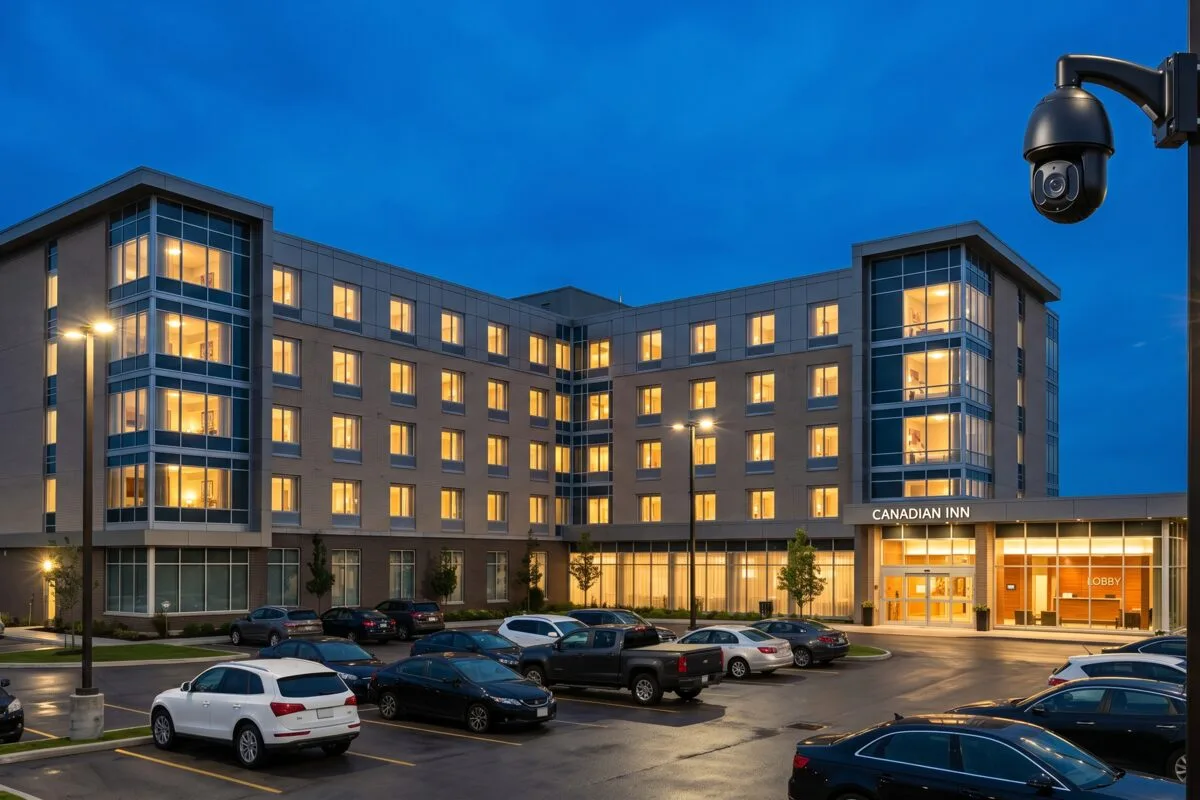
When a guest files a claim after a parking lot break-in or a corridor incident, your insurance position depends entirely on what you can document. Clear, timestamped footage showing the incident, the property conditions, and your security measures changes the outcome of both insurance claims and legal proceedings. Properties without footage pay more — in premiums and in settlements.
Full property coverage in under two weeks
Property Walk & Coverage Assessment
We walk every parking area, entrance, corridor, stairwell, and amenity zone. We identify your current blind spots, access control gaps, and the highest-incident areas based on your property's layout and past history. You see the coverage map before we propose a system.
Camera & Access Installation
4K cameras covering all parking areas, entrances, corridors, and amenity access points. PTZ cameras for large parking lots. Card access control on all exterior doors beyond the main entrance. Installed with minimal disruption to occupancy.
Monitoring & Incident Response
After-hours monitoring on parking lot and exterior entry points. Any motion or access event is reviewed live, and the operator calls police on a confirmed intrusion — not on a motion trip. Incident clip packages for insurance, police, or legal prepared within one hour of a report.
Complete hotel & motel protection
Parking Lot & Perimeter Coverage
4K and PTZ cameras covering all parking areas — front, side, and rear. Clear plate and vehicle detail in low-light conditions. Motion-triggered alerts during overnight hours when vehicle break-ins peak. Coverage designed to eliminate blind spots that organized vehicle crime rings exploit.
Main Entrance & Lobby Monitoring
Cameras covering the main entrance, lobby, and front desk from multiple angles. 24/7 footage available for any guest dispute, incident review, or police request. Clear facial identification at arrival supports any subsequent investigation.
Corridor & Stairwell Coverage
Cameras covering all floor corridors and stairwells — the zones where room theft, vandalism, and assault occur with minimal staff presence. Coverage visible to guests deters opportunistic incidents; footage available for any report within minutes.
Access Control on Exterior Doors
Card access on all exterior entry points beyond the main entrance — side doors, rear entrances, parking lot stairwells, pool, and fitness access. Revoke credentials instantly. Full audit trail of every door event available for incident review or police.
Amenity Area Monitoring
Cameras covering pool, fitness centre, and shared amenity access points — both for guest safety and after-hours trespass deterrence. Motion alerts on amenity areas after designated closing hours. Reduces liability exposure in guest injury and unauthorized-access incidents.
Insurance & Legal Documentation
Every incident produces a timestamped clip package ready for your insurer or legal team within one hour. System installation documentation and monitoring certificates submitted for commercial property and liability premium review. Most Ontario hotel and motel operators see measurable premium reductions within one renewal cycle.
Client Results
What hotel & motel security clients say
“A guest claimed they were robbed in their room and demanded full compensation. Our cameras showed the room was accessed only by the guest and no one else had a key event in the system. We declined the claim and provided the footage to the police. The guest stopped pursuing it.”
“The parking structure was our biggest liability — three vehicle thefts in two years. After Riowell added full perimeter coverage and licence plate capture at the entry, we've had zero thefts and two attempted break-ins that were disrupted before anything was taken.”
“Riowell integrated card access with time windows so housekeeping can only enter occupied rooms during scheduled hours. Any deviation triggers an alert. We've had zero guest complaints about unauthorized room entry since, and our front desk doesn't spend two hours a week fielding those calls anymore.”
“We had three parking lot break-ins in one summer and two insurance claims. After Riowell installed cameras covering the whole lot, we had two deterred attempts in the next six months — the suspects saw the cameras and left. When one attempt did happen, we had the footage for police and the whole thing was documented. Our broker reduced our liability premium 19% at renewal.”
Every guest protected.
Every incident documented.
Book a free property walk-through. We'll map every parking blind spot, corridor gap, and access control weakness — and design a system that protects guests, staff, and your liability position.
Security for Hotels & Motels beyond Mississauga
We cover Mississauga and 14 other Southern Ontario communities. Every location gets the same technicians, the same equipment, and the same response commitment — pick yours below.
Related properties we protect
Frequently Asked Questions
Ready to secure
your business?
Book a free on-site assessment. We'll evaluate your property and design a custom security and IT solution — no pressure, no commitment.