Customer vehicles safe.
Every overnight shift documented.
The average Ontario auto body shop holds 10–30 customer vehicles overnight — worth $300,000 to $1.5M on the lot. Catalytic converter theft, after-hours vehicle theft, and parts strip incidents target body shops specifically because vehicles are stationary, often partially disassembled, and left unattended. We install camera and monitoring systems that protect your lot, document every overnight incident, and give you the evidence your insurer requires when customer vehicle damage is claimed.
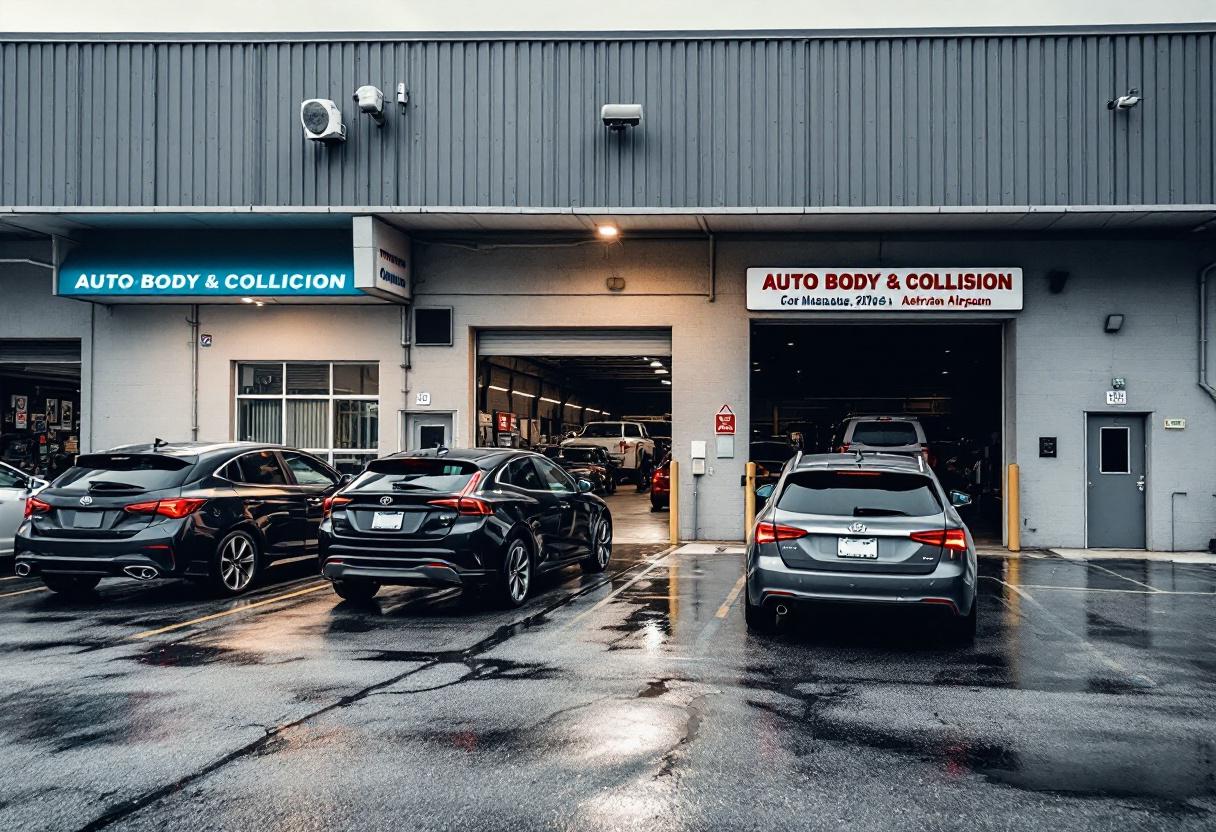
The cars on your lot are not yours to lose.
A body shop is holding other people's vehicles, often for weeks, often partly disassembled. That is a custody problem before it is a theft problem. Two things drive most of the pressure in this trade: what happens on the lot between close and open, and the recurring argument about whether a mark on a panel was there when the car came in.
Usually read by: Shop owner / collision centre manager
The shop owner
- Your day
- You are quoting, chasing parts, dealing with insurers, and locking up at the end of the day with ten to thirty vehicles outside that belong to customers. You know which ones have no wheels on them and which corner of the lot the light does not reach.
- What you're judged on
- An overnight hit on a customer's car. Your own equipment is a loss you can absorb; a converter cut out from under a vehicle you were trusted with turns into a claim, a rental extension, a delayed delivery and a phone call you have to make yourself.
The collision centre manager
- Your day
- You are moving cars constantly — intake to teardown, teardown to paint, paint to the back lot, back lot to delivery. Keys go from the lockbox to a technician to a hook and back, several times a day, on vehicles that do not stay where the board says they are.
- What you're judged on
- Cycle time and insurer scorecards. Anything that pauses a job — a stolen converter, a damaged panel in dispute, a vehicle that has to go back into the booth — shows up on the numbers you are measured on before it shows up anywhere else.
The estimator at the front counter
- Your day
- You do the walk-around at intake, take the photos, write the sheet, and you are the one standing there at delivery when the customer finds something they say was not there before. You are also the person who took the after-hours drop-off through the mail slot with no walk-around at all.
- What you're judged on
- Being the sole word against a customer's memory. Intake photos help, but a customer who is convinced will dispute the photos too, and the easiest way to end the argument is to write it off and eat the repair.
A saw runs in the back lot at 1 AM. Who hears it?
On most shops, nobody. Fences are low, the building alarm covers the building and not the asphalt, and the neighbours are industrial units that are also empty. The realistic sequence today is that the owner finds out at opening when a technician reports a vehicle sitting nose-down or a car sounding wrong when it is started. With after-hours monitoring the motion in the vehicle rows puts an operator on the feed within seconds and police are called on a confirmed person in the lot rather than on a sensor. Cutting a converter is quick work, so nothing about this is a guarantee — the honest gain is that a crew that gets challenged by an audio warning or sees a real response usually leaves the rest of your lot alone and does not come back.
Same protocol whether the site is in Mississauga or anywhere else we cover.
The things people in your position actually ask us
“The customer says the scratch was not there when they dropped it off, and I cannot prove otherwise.”
This is what a camera on the intake area is actually for. A view of the vehicle arriving and being driven to the bay, timestamped, sits behind your walk-around photos and is much harder to argue with than photos alone. It also covers the after-hours drop-off, which is where most of these disputes start because nobody walked around the car with the customer. We are not claiming this wins every argument, but it changes most of them from a negotiation into a review.
“Half the cars in my lot are apart. No wheels, no glass. What is a camera going to do?”
For a vehicle already on stands, a camera does not prevent the cut — it shortens the time before someone responds and it identifies who was there. That is why coverage of the rows matters more than coverage of the fence line on a body shop lot. And some of the honest answer is not a camera at all: parking teardown vehicles tight together, nose-in against the building rather than out at the fence, removes the access a crew needs before any camera is involved.
“Keys live in a lockbox in the office and vehicles get moved a dozen times a day.”
Coverage of the lockbox and the office door is the practical control, because a key movement becomes a timestamped event you can go back to. What we would not recommend is trying to track every key handoff through a system — in a shop that busy it gets ignored within a fortnight. Cover the box, cover the bay doors, and use the footage on the rare occasion you need it.
“My technicians park their own cars in the lot. I am not filming my own guys all night.”
The cameras that matter here are aimed at the vehicle rows, the bay doors and the perimeter, and staff vehicles happen to be in that frame. That works in your technicians' favour more often than not — their own cars sit in the same lot as the customer vehicles, and they are the first people questioned when something goes missing overnight. We handle the notice and signage side and document what gets recorded and for how long, rather than leaving it as something the shop guesses at.
“We lease the building. I cannot start drilling walls and running conduit.”
Common in this trade, and it is a design constraint rather than a blocker. Positions can go on existing light standards, fence posts and soffit, and cabling can be run in surface conduit that comes off cleanly. Bring your landlord into the conversation before the survey — a shop that gets written approval on four positions beforehand avoids the far more expensive version of this argument at the end of a lease.
“We put everything inside the building overnight anyway.”
Then your exposure is much smaller than this page assumes, and you should buy much less than it describes. A shop that genuinely brings every vehicle inside and has only the bay doors and a man door as openings needs coverage on those openings, on the parts room, and on intake — not a lot system. We would rather quote that and be honest about it than sell you rows of cameras watching an empty yard.
Customer vehicles. Your liability.
Auto body shops hold customer vehicles in trust. When a vehicle on your lot is broken into after hours, has its catalytic converter stolen, or is damaged by a third party overnight, you bear the liability — unless you can document that the damage occurred without negligence on your part. Cameras covering your full lot and all entry points change that liability equation.
Catalytic converter theft is the most frequent after-hours incident Ontario body shops face. Thieves with a battery-powered saw can cut a converter in under 90 seconds. Body shops are targeted specifically because vehicles are stationary and often jacked up or on dollies — easier converter access than in a regular parking lot. A perimeter camera with motion-triggered monitoring and sub-30-second police dispatch is the only countermeasure that deters converter crews before they complete the job.
In Mississauga, auto body shops face the same catalytic converter theft and overnight vehicle lot risks seen across the Peel Region region. Our camera and monitoring systems give Mississauga shop owners and collision centres complete lot coverage — deterring theft crews and documenting every overnight hour for liability protection.
Case Study — Ontario Collision Centre
An independent collision centre in the GTA experienced four catalytic converter thefts in one quarter — three customer vehicles, one in-shop vehicle. Total cost including parts, labour, and customer management: $14,000. Riowell installed lot cameras and after-hours monitoring. One attempted theft was flagged three months later — crew arrived at 2 AM, monitoring dispatched police, crew fled before completing the cut. Zero thefts in the 12 months following installation.
High-Risk Areas in Auto Body Shops
Auto Body Shop Security in Mississauga — what we actually see.
Mississauga body shops sit in the centre of Ontario's worst auto theft region. Peel Regional Police have documented consecutive years of record vehicle theft across Mississauga, and the body shop population on Dixie Road, Burnhamthorpe Road, Hurontario Street, and the Cawthra/Matheson corridor absorbs the downstream effects: customer vehicles in for repair that match high-theft profiles are targeted for catalytic converter removal and parts stripping. Proximity to Pearson International Airport adds another layer — converter theft rings operating in the Pearson logistics corridor use the same route infrastructure as airport cargo theft teams, and body shop lots on Dixie Road and Eglinton Avenue West sit within their established circuit. We are based in Mississauga. We drive these streets regularly. The pattern we observe consistently is that shops with clearly mounted, visible cameras on a monitored system have been bypassed in favour of unprotected neighbouring lots.
Peel Region's #1 vehicle theft status directly hits body shops
Every stolen vehicle that ends up in a Mississauga body shop for insurance repair carries risk. Converter theft crews that operate the Dixie and Hurontario corridors know the shop layouts and target vehicles matching their most profitable converter profiles.
Home-base response advantage
Our installation team is based in Mississauga. A new shop can have cameras and monitoring active within 48 hours of signing — faster than any GTA-based competitor. If a system component fails overnight, our team is on-site in the morning.
Peel Police pre-registration
We pre-register every Mississauga shop address with Peel Regional Police — gate codes, lot maps, and escalation contacts. Officers aren't navigating locked gates during live callouts. That pre-staging adds meaningful response speed on a real incident.
Police Coordination — Mississauga
We dispatch directly to Peel Regional Police — Mississauga South (11 Division) or Mississauga North (12 Division) based on shop location. Gate access codes and lot layouts are pre-staged at both divisions so officers reach the vehicle lot, not the locked front gate, on any live callout.
Client Story — Mississauga
Collision centre, Dixie Road corridor — 13 months under monitoring
15-bay collision centre, average 12 customer vehicles overnight. Prior 18 months: four converter thefts (two on customer vehicles, two on in-shop loaners) totalling $11,600 in parts and labour, plus one parts-storage break-in ($3,800 in stolen paint). We installed 12 cameras covering the full vehicle lot, parts storage entry, bay access door, and two gate positions. Live monitoring, 9 PM to 6 AM. In 13 months: three converter crew approaches flagged, all stopped by audio talk-down before any cut was made. One Peel Police dispatch resulted in an on-site trespass arrest. Zero converter thefts. Garage-keeper liability premium reduced at the next renewal.
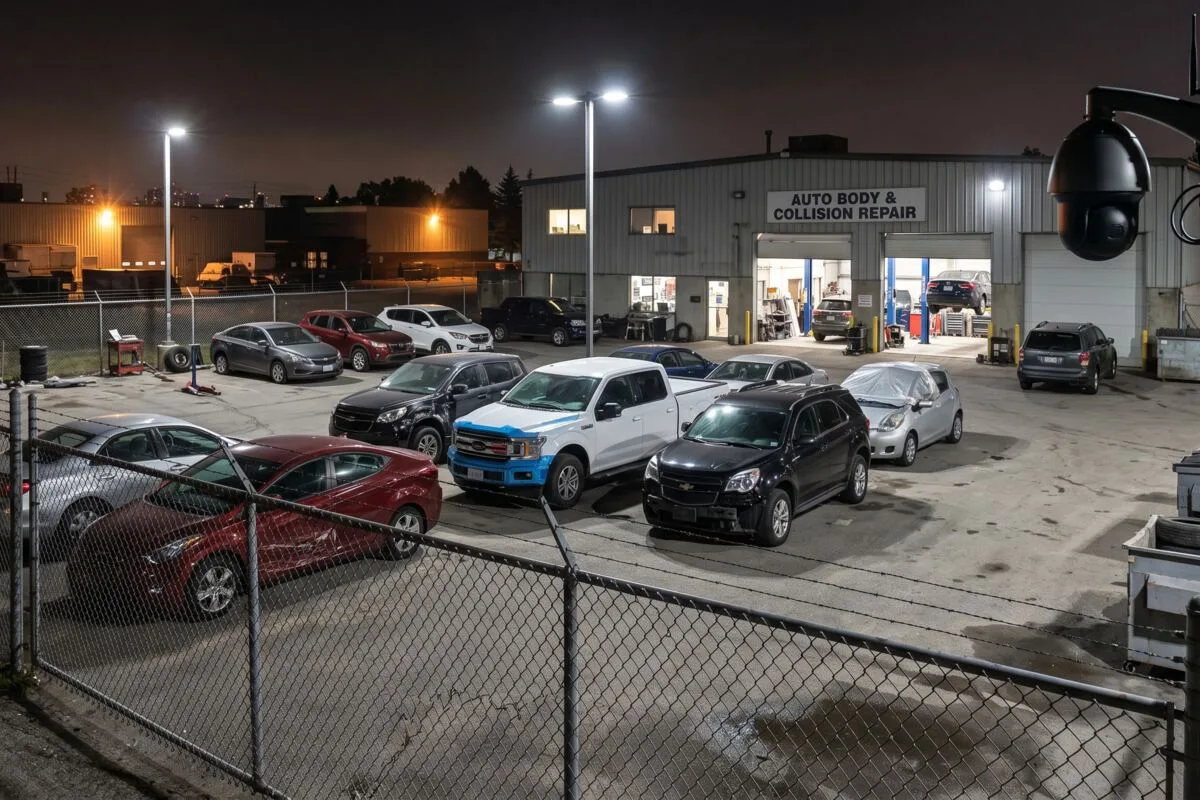
Liability Protection
You hold their vehicle.
You hold the liability.
When a customer picks up their vehicle and finds damage, missing parts, or a stolen converter that wasn't in the repair order, your documentation is everything. Clear overnight footage showing the condition of the vehicle on intake and every subsequent hour on your lot converts a he-said/she-said dispute into a documented event — with or without a police report.
Full lot coverage in under a week
Shop Walk & Coverage Assessment
We walk your full lot, perimeter, bay entrances, and parts storage areas. We identify every camera gap and access point that after-hours crews exploit. You see the coverage map before we propose a system.
Camera & Perimeter Installation
4K cameras covering all vehicle parking areas, lot perimeter, bay entrances, and parts storage access. Motion-triggered alerts on overnight access zones. Installed during business hours with no disruption to your shop workflow.
Overnight Monitoring & Dispatch
Live monitoring after close. Any motion in the vehicle lot or perimeter breach puts a live operator on the feed within seconds, and police are called on a verified intrusion rather than an unconfirmed sensor trip. Converter theft crews require 60–90 seconds on site — early dispatch is the difference between deterrence and a completed theft.
Complete auto body shop protection
Customer Vehicle Lot Coverage
4K cameras covering every vehicle parking position on your lot — front-to-back with overlapping fields of view. IR night vision optimized for the low-light outdoor conditions where converter theft occurs. Every vehicle visible, every overnight access event recorded and timestamped.
Perimeter & Gate Monitoring
Cameras covering all lot entry points, perimeter sections, and fence lines. After-hours motion alerts with live operator monitoring. Organized converter crews typically drive by a target before committing — visible cameras on the perimeter change the risk assessment before a crew parks.
After-Hours Dispatch Response
Any after-hours lot intrusion is reviewed by a live operator who confirms what is actually happening before making the call to police. Catalytic converter theft takes 60–90 seconds. A monitored system that dispatches police before the crew finishes is the only effective countermeasure for converter theft — cameras alone don't stop a crew that expects no response.
Parts & Equipment Coverage
Cameras on parts storage rooms, paint booth access, and tool storage areas. High-value paint materials and specialty tools are secondary targets once a crew is already on your lot. Complete coverage means a single perimeter breach doesn't give access to multiple theft opportunities.
Vehicle Condition Documentation
Timestamped intake footage tied to each vehicle's arrival time creates a chain-of-custody record for every car on your lot. When a customer disputes the condition of their vehicle at pickup, you have footage of intake, overnight, and departure — resolving disputes that would otherwise become insurance claims or legal proceedings.
Insurance & Legal Documentation
Incident packages for police and insurers prepared within one hour. Installation documentation and monitoring certificates for commercial property premium review. Ontario body shops with documented operational monitoring systems typically see measurable reductions on property and garage-keeper liability premiums within one renewal cycle.
Client Results
What auto body shop security clients say
“We had a customer vehicle go missing overnight — parked in our secure lot, keys in the lockbox, gone by morning. Riowell installed cameras covering every angle of the lot and the lockbox access point. The police found the vehicle, and the footage was central to the case. We now use it for insurance documentation on every vehicle intake.”
“Parts inventory was disappearing — about $800 a month in small items. Couldn't figure out if it was customers or staff. Riowell covered the parts room entrance and the counter. The issue was identified in three weeks and handled internally. Theft stopped and we've recouped more than the system cost in the first year.”
“A customer alleged we damaged their vehicle during repair. Our intake photos showed the damage as pre-existing, but they disputed the photos as staged. The Riowell footage showed the vehicle arriving and being driven straight to the bay — matching the photos exactly. Claim denied. That footage is now part of our standard intake SOP.”
“We had four catalytic converter thefts in three months — three on customer cars. The liability was a nightmare. After Riowell installed the cameras and monitoring, we had one attempted theft three months later. Monitoring called the police while the crew was still on the lot. They left without completing the cut. We've had zero converter thefts in the year since.”
Customer vehicles safe.
Every incident documented.
Book a free shop walk-through. We'll map every lot blind spot, perimeter gap, and access vulnerability — and design a system that deters converter crews, protects your liability, and documents every overnight hour.
Security for Auto Body Shops beyond Mississauga
We cover Mississauga and 14 other Southern Ontario communities. Every location gets the same technicians, the same equipment, and the same response commitment — pick yours below.
Related properties we protect
Frequently Asked Questions
Ready to secure
your business?
Book a free on-site assessment. We'll evaluate your property and design a custom security and IT solution — no pressure, no commitment.